India · Blogging Income
How to Earn Money from a Blog in India in 2026: 9 Real Methods (With Honest Timelines)
Let us start with the part most guides hide: months 1–3 usually earn almost nothing. A blog is a compounding asset, not a salary. If anyone promises ₹50,000 in month one, close the tab. What follows is how to earn money from a blog in India — method by method, with the timeline each one really takes.
Honest timelines first
| Phase | What happens | Realistic income |
|---|---|---|
| Months 1–3 | Setup, first 20–30 posts, Google starts indexing | Almost zero — this is building, not earning |
| Months 4–8 | Long-tail posts rank, first AdSense/affiliate clicks | Small, irregular — proof of concept |
| Months 9–18 | Topical authority builds, traffic compounds | Real earnings become possible if you published consistently |
| 18+ months | Sponsored interest, services & products layer on top | Where most serious Indian bloggers' income actually comes from |
Pick a niche that pays in India
Traffic alone does not pay — advertiser demand does. Niches with buyers in India: finance basics, jobs & exams, tech how-tos, hosting/software, education, health information (careful, high trust bar), and local services. Passion matters for stamina, but check that businesses in the niche sell something — that is where affiliate and sponsored money comes from.
Set up: costs in ₹
- ₹0 route: Blogger free — fine to learn, weak control and monetisation ceiling.
- Serious route: WordPress on budget hosting + your own domain. Your real costs are domain + hosting (see our ₹ comparison in Guide #8) plus GST where applicable — that is it. Anyone selling you expensive “blogging setup” before you have traffic is selling, not helping.
See cheapest hosting in India (₹) →
The 9 real methods
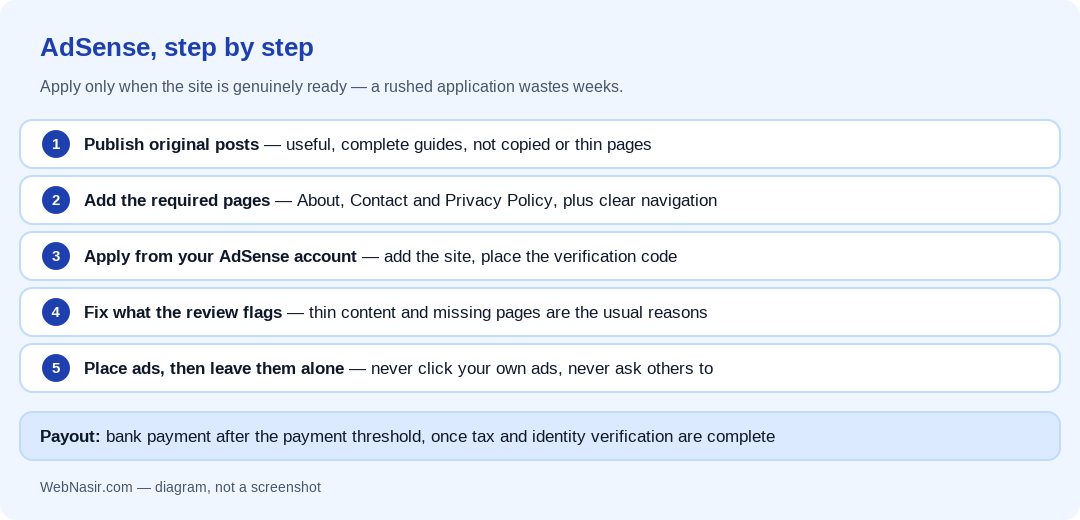
- Google AdSense — apply after you have original, useful posts and the required pages (About, Contact, Privacy). Payout rules matter: never click your own ads, never ask friends to click — it gets accounts banned permanently.
- Affiliate — Amazon Associates — honest reviews/comparisons; disclose affiliate links.
- Affiliate — EarnKaro / Cuelinks — often better fit for Indian shopping deals than Amazon alone.
- Sponsored posts — brands pay once you have niche traffic; always label sponsored content.
- Your own services — for most small blogs this is the biggest earner: a web designer, tutor, consultant or freelancer blogging in their niche gets clients worth far more than ads.
- Digital products — notes, templates, checklists, mini-courses sold to the audience you already serve.
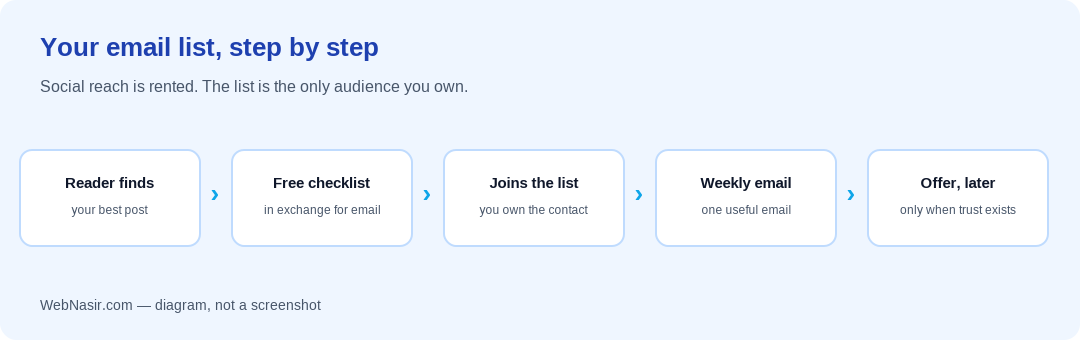
- Email list + offers — an email list is the only audience you own; social reach is rented.
- Freelance writing from your blog as portfolio — your posts prove skill to clients (see Guide #7).
- Flipping / growing a second niche site — advanced, only after method 1–6 work once.
Tax & payout basics (India)
Blog income is taxable income — keep invoices, AdSense payment records and affiliate statements in one folder from day one. AdSense pays to your bank after you cross its payment threshold and complete tax/identity verification. As income grows, talk to a CA about GST applicability and TDS on sponsored/affiliate payments — do not guess once money is regular.
Your 90-day plan
- Days 1–7: niche + domain + WordPress live (Guide #8 for hosting).
- Days 8–30: 10 cornerstone guides targeting low-competition long-tails — quality over daily thin posts.
- Days 31–60: 10 more posts, internal linking, Search Console review, fix what Google actually shows impressions for.
- Days 61–90: apply AdSense, join Amazon Associates + EarnKaro, publish 2 honest comparison posts, start an email list.
Pair this with: Start Freelancing in India →
Freelancing course note: if you want clients faster than blog traffic grows, freelancing (Guide #7) pays sooner — many Indian creators run both: services for cash flow now, blog for compounding later.
How to earn money from a blog in India with AdSense: the full process
Google AdSense is the method most Indian bloggers start with, and it is also the method most beginners misunderstand. AdSense places advertisements on your blog, and Google pays you a share of what advertisers spend when readers see or click those ads. You never sell anything, never talk to an advertiser, and never handle a payment from a reader. That simplicity is exactly why it is the default first step — and exactly why it pays so slowly at the start. Advertising money follows traffic, and a new blog has almost no traffic. In months 1–3, when the original timeline in this guide says income is almost zero, AdSense is usually the reason that sentence is true: the ads are live, the clicks are rare, and the balance barely moves. That is normal. AdSense is not broken, and your blog is not failing. It is simply a method that only starts working once real readers arrive in real numbers, which is why every other method in this guide exists alongside it.
Before you apply, your site has to look like a real publication rather than a half-finished experiment. That means original posts that actually answer the question in the title — complete guides, not two-paragraph summaries copied from somewhere else. It means the required pages the original list mentioned: an About page that says who runs the blog, a Contact page with a working way to reach you, and a Privacy Policy that explains cookies and advertising. It also means clean navigation, a working search or category structure, and no broken pages, placeholder text, or lorem ipsum anywhere a reviewer might click. Google reviews the site as a reader would, and a site that looks unfinished gets the same answer as a site with copied content. Spend a week making the blog look finished before you spend a minute on the application itself.
The application itself is straightforward, and you should follow it in order rather than skipping ahead. First, create an AdSense account with the same Google account you use for Search Console, and add your blog as a site. Google will give you a small verification code to place in your site, which proves you own it. Then submit the site for review. A reviewer — human, not just automated — looks at the content, the pages, and the overall quality of the site, and the review can take days or longer. If the site is approved, you place ad units on your pages and ads start appearing. If it is not approved, Google tells you the broad reason, and that reason is usually one of two things: content that is too thin or too similar to what already exists, or a site that is missing the basic pages. Both are fixable, and both are worth fixing properly instead of reapplying the next day with nothing changed.
Once ads are running, the only lever you genuinely control is the quality and focus of your content, not the ads themselves. Posts that answer a specific question attract readers who came with intent, and advertisers pay more to reach readers with intent than readers who arrived by accident. That is the whole reason the niche section of this guide matters so much: a finance basics post and a general entertainment post can have the same number of readers and very different advertising value, because businesses compete to reach the finance reader. Where you place ads matters too, but only within limits — ads inside the content flow where a reader naturally pauses tend to perform better than ads buried in a footer nobody reaches, and cramming every gap with ad units drives readers away faster than it earns. One or two well-placed units on a clean page beats five units on a page that looks like a billboard.
Two rules about AdSense are absolute, and breaking either can end your account permanently. Never click your own ads, and never ask friends, family, or readers to click them — Google detects invalid activity, and a banned account is almost never reinstated. Treat the ads as furniture: they sit on the page, readers use them or they do not, and your job is the content around them. The second rule is about patience with payouts. AdSense pays to your bank only after you cross its payment threshold and complete tax and identity verification, so the first payout always takes longer than beginners expect. Keep your payment records in the same folder as your invoices and affiliate statements from day one, because the tax section later in this guide assumes you did. AdSense is a slow, honest income stream — it rewards a blog that is still publishing useful posts a year from now, not a blog that chased a payout in week three.
Affiliate income: Amazon Associates, EarnKaro and Cuelinks
Affiliate marketing is simple to explain and hard to do well. You recommend a product in a post, the reader clicks your special link, buys the product, and the seller pays you a commission. You never handle stock, shipping, or customer support. The blog does the selling while you sleep, which is why affiliate income sounds so attractive in every guide — and why it disappoints so many beginners. The hard part is trust. A reader only buys through your link if they believe your recommendation, and belief is earned one honest post at a time. A blog with ten genuine, detailed reviews earns more from affiliate links than a blog with a hundred posts that all say every product is amazing. Readers can tell the difference, and so can Google.
Amazon Associates is the programme most Indian bloggers join first, because the range of products is enormous and readers already trust Amazon checkout. It works best where the post is a genuine buying decision: a review of a product you have actually used, a comparison between two or three options, or a best-of list where each pick earns its place. The honest way to write these posts is to describe who the product suits and who it does not suit, because a reader who buys the wrong product on your recommendation will never trust your next one. Always disclose that the post contains affiliate links, in plain language near the top of the post, not hidden in a footer. Disclosure is not just a rule — it is what makes the recommendation believable. A reader who knows you earn a commission and still clicks is a reader who trusts you.
EarnKaro and Cuelinks often fit Indian readers better than Amazon alone, and the original list flagged this for a reason. Both work across many Indian stores rather than a single marketplace, which matters because your readers do not all shop in one place — some buy from Amazon, some from Flipkart, some from brand stores during a sale. A deals or offers post that links to the same product across several stores through one of these networks can serve more readers than an Amazon-only link, and festive-season posts, where Indian shopping genuinely spikes, are where this shows most clearly. The same honesty rules apply: disclose the links, recommend products you would genuinely suggest to a friend, and never publish a deal you have not checked. A dead link or a wrong price in a deals post costs you the reader who clicked it.
The posts that earn affiliate income are rarely the posts that chase the biggest keywords. A broad post titled with a popular product name competes with every major review site on the internet. A specific post — a comparison for a particular budget, a guide for a particular use, a solution for a particular problem — competes with almost nobody, and the reader who finds it is usually ready to buy. That is the same long-tail logic the 90-day plan uses for its cornerstone guides, applied to earning: ten specific, honest buying guides beat fifty generic ones. Check your links regularly, because products go out of stock and prices change, and a post full of dead links is a post that stops earning quietly. Affiliate income compounds the same way traffic does — slowly, then noticeably — but only on posts that were honest on the day they were written.

Sponsored posts and brand deals in India
Sponsored posts are the point where a blog stops being only a traffic asset and starts being a media property: a brand pays you to write about its product or service, usually a fixed fee for one post, sometimes a fee plus a product. Brands find blogs the same way readers do — through search, through social media, and through recommendations from other creators. A small blog in a tight niche can attract sponsors earlier than a large general blog, because the brand is buying access to a specific audience, not a raw visitor count. A blog about government exam preparation with a few thousand focused readers is more useful to an ed-tech brand than a general blog with ten times the traffic and no clear audience at all. That is why the niche advice in this guide keeps coming back to focus: sponsors pay for focus.
What you charge for a sponsored post depends on too many factors for any guide to give you a single number — your niche traffic, how engaged your readers are, what the brand is asking for, and whether the post will stay on your site permanently all change the value. The honest way to think about it is to start from the work involved: the hours of writing, the size of the audience that will actually see it, and what a similar placement would cost the brand elsewhere. For your first brand deal, a clear written scope matters more than a clever price: what you will write, how long the post stays live, whether the brand can ask for revisions, and whether you will share it on social media. Put it in an email or a simple document before you write a word, because a friendly chat message is not an agreement, and misunderstandings after publication are far harder to fix than a clear scope before it.
Every sponsored post must be labelled as sponsored, clearly and near the top, and the label is not negotiable. Readers forgive a sponsored post from a blogger they trust; they do not forgive discovering afterwards that a recommendation was paid for. The same honesty applies to the content itself: a sponsored post should still be useful, still accurate, and still sound like you. If a brand asks you to claim something you do not believe, or to hide a real downside of the product, the right answer is to decline — one bad sponsored post costs more in lost trust than the fee was ever worth. Brands that respect your audience will respect that boundary, and the ones that do not are not brands you want a long relationship with. Your readers are the asset; the sponsor is renting access to them for one post.
If you want brand deals rather than waiting for them, start with the brands you already use and genuinely like. Write to them with a short, specific email: who your readers are, what your best posts are, and one concrete idea for a post that would help their customers. Avoid the long media kit full of vanity numbers — brands see dozens of those a week. A short email with three links to your best work and one good idea beats a ten-page PDF every time. Expect most emails to go unanswered, especially at first; that is normal, and it is not a verdict on your blog. The first deal is the hardest to get, because you have no previous brand work to show. After that, each completed sponsored post becomes the proof that gets the next one, which is another reason to do the first one properly rather than cheaply.
Services: the fastest money for most Indian bloggers
For most small blogs, services are the biggest earner — and the original list says so plainly, because it is the least glamorous and most true statement in this guide. The logic is simple arithmetic without any invented numbers: an advertiser pays you a tiny amount per reader, but a client pays you for a finished piece of work. One web design project, one month of tutoring, or one consulting engagement can be worth more than months of early advertising income, and it arrives while your traffic is still small. That is why the timeline in this guide puts services alongside the later phases — not because services take long to start, but because most bloggers overlook them while chasing ad income that is still months away. If you have a skill your niche needs, services are not a distraction from the blog. They are the cash flow that lets you keep blogging.
The services that work are the ones your niche already wants. A web designer blogging about websites gets design clients. A tutor blogging about exams gets students. A consultant blogging about small business gets consulting calls. A writer blogging about writing gets writing work. The pattern is that the blog proves the skill before the client ever talks to you: every post is a sample of how you think, how clearly you explain, and how seriously you take the subject. That is why a blog in a niche you genuinely work in converts better than a blog in a niche you only write about. When a reader has already learned something useful from you for free, hiring you feels like the obvious next step rather than a leap of faith.
Turning readers into enquiries needs almost no machinery, but it does need to be deliberate. A simple services page that says what you do, who it is for, and how to contact you is enough to start — one page, written plainly, linked from your navigation and from the end of your most relevant posts. A contact form or an email address is all the technology required. What matters is proof: a short description of work you have done, even for one client or one personal project, and a clear statement of what happens next when someone contacts you. Readers do not enquire when they cannot tell what they will get or what it will cost them in time. Tell them the first step, and make the first step small — a short call, a message, a question — so that contacting you feels easy rather than committing.
Pricing services honestly means charging for the outcome, not for the hours, and starting with a scope you can actually deliver. A vague promise to do everything for a low price ends with an unhappy client and a blogger who resents the work; a clear, small engagement — one website, one month of lessons, one audit — ends with a finished job and a testimonial you can show the next client. You do not need to publish your prices on the site, but you do need to know them before the first enquiry arrives, because hesitating on price in the first conversation tells a client you are unsure of your own value. Start with work you can do well, deliver it properly, and raise your prices as your portfolio and your waiting list grow. The blog keeps bringing the enquiries; the quality of the work keeps raising what those enquiries are worth.

Digital products Indian readers actually buy
A digital product is something you make once and sell many times: exam notes, a template, a checklist, a spreadsheet, or a short mini-course. It is the method that sounds most like passive income, and it is the method where beginners most often build the wrong thing first. The reason is simple: a product only sells if it solves a problem your readers already have, and you only know what that problem is if you have been listening to them. A blogger who has answered the same question from readers twenty times already knows what the product should be — the notes, the template, or the checklist that answers that question properly. A blogger who guesses what readers might want usually builds something nobody asked for, and then wonders why a product page with no visitors does not sell.
Before you build anything, validate the idea with the smallest possible test. Ask your readers directly — in a post, in an email, or in the comments — what they struggle with and what they would pay to have solved. Better still, offer a small version first: a free checklist that proves the idea is useful, and watch whether people actually download it and use it. If a free version gets ignored, a paid version will not magically sell. If the free version gets shared and requested, you have found a real problem, and the paid version can go deeper: more detail, more examples, worked answers, templates the reader can use immediately. Building in that order — proof first, product second — is what separates a product that earns from a product that sits on a sales page.
Selling to Indian readers means keeping payment simple. Most of your readers will expect UPI or a straightforward payment link, and the fewer steps between deciding and paying, the more sales complete. Whatever route you choose, keep it boring and reliable: a clear price, a clear description of exactly what the buyer receives, and a delivery that arrives immediately after payment. Keep a record of every sale — buyer, date, amount, and what was delivered — in the same folder as your invoices and affiliate statements, because digital product income is taxable income just like every other method in this guide. If a buyer asks for a refund because the product did not match its description, treat that as information about your description, not as an attack, and fix the description.
Pricing a first product is a judgement call, and the honest approach is to start small and learn. A short, focused product at a modest price sells more copies and teaches you more about your buyers than an expensive, sprawling product that nobody finishes. Your first buyers are also your best source of improvement: ask them what was missing, what confused them, and what they would want next, and then update the product. A digital product is never truly finished — the second version, informed by real buyers, is almost always better than the first. Over time, a small catalogue of focused products, each solving one real problem for one real audience, earns more steadily than a single big course that tries to solve everything at once. The blog brings the readers, the free content builds the trust, and the product is simply the deeper version for the readers who want more.
Email list: the audience you actually own
An email list is the only audience you own, and the original list says it in one sentence because the sentence is the whole argument. Social media reach is rented: a platform can change its algorithm, limit who sees your posts, or suspend your account, and your audience disappears overnight. Search traffic is borrowed too — Google can change what it ranks, and your best post can slide. An email list is different. When a reader gives you their email address, you can reach them whenever you have something worth saying, without asking any platform for permission. That is why every method in this guide gets stronger once a list exists: new posts get readers on day one instead of waiting for search, new products get buyers who already trust you, and a quiet month of traffic does not mean a quiet month of income.
People join a list for a reason, and that reason is almost always a specific, useful thing rather than a vague promise to send updates. The classic exchange is a lead magnet: a checklist, a template, or a short guide that solves one problem, offered at the end of the post where that problem is discussed. A reader who just finished your post about exam preparation is far more likely to download a revision checklist than to subscribe to a general newsletter, because the checklist is the next step in what they are already doing. Make the lead magnet genuinely useful on its own — not a teaser that withholds the real content — because the reader judges your paid offers later by the quality of the free thing you gave them first. One good lead magnet, offered on your best posts, beats five mediocre ones scattered everywhere.
The habit that makes a list valuable is simple and undramatic: one useful email a week. Not a sales pitch every week, and not a long essay nobody finishes — one short email with something genuinely helpful, a link to your newest post, and, occasionally, an offer that fits the readers who have been following along. Most bloggers fail at email not because they cannot write, but because they send three emails in one week and then nothing for two months. Readers forgive a short email; they do not forgive being spammed and then forgotten. Start the list early, even when it has ten subscribers, because a list of ten real readers who open your emails is worth more than a list of a thousand addresses that never do. The list compounds like everything else in blogging — slowly, then all at once.
Freelance writing: your blog as your portfolio
Freelance writing is the method most bloggers stumble into by accident, and it deserves its own section because it is often the first money a blog produces. The mechanism is straightforward: your posts are public proof that you can research a subject, explain it clearly, and finish what you start. A client hiring a writer has one problem — they cannot tell from a CV whether a stranger can actually write — and your blog answers it before they even ask. That is why the original list describes the blog as a portfolio: every published post is a writing sample, available to anyone, at any hour, without you having to send anything. A writer with twenty good posts and no pitch often gets hired faster than a writer with a polished CV and nothing public to show.
Finding the first clients is a matter of showing up where clients already look. Content agencies and publications that publish in your niche regularly need writers, and many list openings openly. Direct pitches work too: a short email to a site you already read, pointing to two or three of your best posts and suggesting one specific article idea, is far more effective than a generic message asking if they need writers. Your own network matters as well — tell people you know that you write, because the first client is often someone who already knows you and simply did not know you were available. Expect rejection and silence, especially at first; pitching is a numbers game, and the posts you already published are what make each pitch credible.
As with services, the honest way to price freelance writing is to start with work you can deliver well and raise your prices as your portfolio grows. Charge per piece rather than per hour where you can, because a fast, experienced writer should not earn less for being efficient. Keep every published client piece as a portfolio link, and keep a record of every payment in the same folder as the rest of your blog income. Over time, freelance writing and blogging feed each other: the blog brings clients, the client work sharpens your writing, and the sharper writing makes the blog better. It is also the fastest answer to the question this guide opened with — if you want clients faster than blog traffic grows, freelancing pays sooner, and many Indian creators run both, services for cash flow now and the blog for compounding later.
A second site or flipping: advanced, and only later
Flipping means building a blog, growing its traffic and income, and then selling it to a buyer who wants an established site rather than starting from zero — or building a second niche site once the first one works. It sits last in the original list for a reason: it is the only method here that assumes you have already succeeded at the earlier ones. A site is worth buying only if it has real traffic, real income, and content a buyer can maintain, and all three take the same months of consistent publishing this guide has been describing. A blogger who starts a second site before the first one earns is usually just running from the hard part — the months where the first site needs steady work and returns almost nothing.
The honest test for whether you are ready is whether methods one to six have worked at least once. If AdSense or affiliate income has arrived, if a service client has come through the blog, or if a digital product has sold to a real reader, then you understand the full cycle from post to payment — and a second site is a genuine expansion rather than a fresh gamble. If none of those has happened yet, a second site doubles your workload while halving the attention each site receives, and both sites suffer. When the time does come, the second site should be a niche you already understand or one closely related to your first, so that the research, the contacts, and the judgement you built carry over. Flipping is a real way to earn from blogging in India, but it is an exit for a successful site, not a shortcut around building one.
Picking a niche that pays in India: a closer look
The niche section of this guide gave the core rule in one paragraph: traffic alone does not pay, advertiser demand does. That rule deserves a closer look, because it is the decision that shapes everything else — what you write, who reads it, and which of the nine methods can ever work for you. The test is not whether a niche is popular, and it is not whether you enjoy it, although enjoyment matters for stamina. The test is whether businesses in that niche sell something, because affiliate commissions, sponsored posts, and services all depend on a business somewhere being willing to pay to reach your readers. If no business sells anything to the people in a niche, there is no affiliate programme to join, no sponsor to email, and no service to offer — only advertising, and advertising alone is the slowest income of all.
Finance basics and jobs and exams are the clearest examples of niches where Indian demand is real, and they are worth understanding rather than just listing. Finance basics works because banks, brokers, insurers, and apps all compete for the same readers, and a reader comparing savings options or learning about tax is a reader those businesses want to reach. Jobs and exams works because the audience is enormous and motivated — government job notifications, exam preparation, and results draw readers who return again and again through a long preparation cycle — and education companies, coaching institutes, and publishers all sell to exactly those readers. Both niches reward accuracy and honesty more than most, because readers make real decisions based on what they read, and a wrong detail about an exam date or a financial rule costs you trust that takes months to rebuild.
Tech how-tos and hosting and software are strong for a different reason: the reader is usually about to buy something. A person searching for how to do something with a tool, or which hosting plan fits a small site, is close to a purchase decision, and that makes the post valuable to affiliate programmes like Amazon Associates and to software companies that pay for referrals. These niches also suit the services method well — a blogger who writes clearly about websites is the obvious person to hire to build one. Education and local services follow the same pattern at a smaller scale: a tutor blogging about a subject gets students, a local professional blogging about their trade gets enquiries, and the blog becomes the proof of competence that advertising alone can never provide.
Health information deserves its own warning, because the original list flags it with a careful note about a high trust bar. Health readers make decisions that affect their bodies, and both Google and readers judge health content far more strictly than other subjects. A health blog written without expertise, sources, or care will struggle to rank, struggle to earn trust, and struggle to attract sponsors — and that is as it should be. If you do have genuine qualifications or experience in health, the niche can pay well, because health businesses compete fiercely for readers. If you do not, the honest choice is a niche where your knowledge is real. Passion matters for stamina, as the original guide says, but it has to be paired with something businesses will pay to reach and something readers can trust you to explain. Check those three things before you commit months to a niche.

Traffic that earns: SEO basics for Indian blogs
None of the nine methods works without readers, and for most Indian blogs those readers come from Google search. That makes basic search optimisation not a technical extra but the foundation of the whole guide. The starting point is Google Search Console, which is free and which every blogger should connect on day one. Search Console tells you what Google actually shows your site for: which queries brought impressions, which pages got clicks, and which pages Google struggles with. It is the difference between guessing what to write next and knowing it. The 90-day plan already uses this — days 31 to 60 include reviewing Search Console and fixing what Google actually shows impressions for — because the data is always more useful than an opinion about what might rank.
The posts that rank first for a new blog are almost always long-tail posts: specific questions with clear answers, rather than broad topics every major site already covers. A new blog will not outrank established sites for a broad term, but it can absolutely be the best answer to a specific question that a real reader typed — a comparison for a particular budget, a how-to for a particular situation, a guide for a particular exam or tool. Those specific posts bring fewer readers each, but the readers they bring are the ones who stay, click, buy, and enquire, because the post matched exactly what they needed. Ten such posts, each the best answer to its question, build more earning traffic than fifty broad posts that rank on page five and are never seen.
Internal linking is the quiet habit that turns separate posts into a site Google takes seriously. When you publish a new post, link it from two or three older posts where it naturally fits, and link from the new post back to your most important older guides. Readers stay longer because they keep finding the next useful page, and Google understands how your content fits together — which is what topical authority actually means in practice. Covering one niche properly, post by post, until a reader can find everything they need on your site, is more valuable than covering five niches thinly. Authority is not a badge you apply for; it is the natural result of publishing complete, connected coverage of one subject for months.
Old posts deserve attention too, and this is where many bloggers leave money on the table. A post that ranked well a year ago slowly goes stale as prices change, links break, and new information appears — and a reader who finds outdated advice stops trusting the site. Revisit your best-performing posts every few months, update the facts, fix the links, add what you have learned since, and republish them with a current date. The work is smaller than writing a new post, and the return is often larger, because the post already ranks and already has readers. Search Console will show you which posts are slipping; those are the ones to update first.
Language is the last decision, and it matters more in India than in most countries. Most Indian readers search in English, but many search in Hindi or in a mix of both, and the language your readers actually use is the language you should write in. A blog that answers questions the way its readers ask them — including the Roman Hindi phrases people type into Google — will be found more easily than a blog that writes in formal English nobody searches with. The same applies to examples: prices in rupees, exam names readers recognise, apps and stores they actually use. Specificity is what makes a post feel written for its reader, and a post that feels written for its reader is a post that earns.
Tax and payouts in India, in more detail
Blog income is taxable income, and the most important habit in this whole section is the one the original guide states first: keep invoices, AdSense payment records, and affiliate statements in one folder from day one. The reason is not bureaucracy for its own sake. When money arrives from several directions — an AdSense payout, an affiliate commission, a sponsored post fee, a client payment — it is easy to lose track of what came from where, and hard to reconstruct it a year later when you need it. A single folder, updated the day each payment arrives, takes minutes and saves hours. It also protects you: if a platform ever questions a payment, or a client ever disputes an invoice, the record is already there.
AdSense payouts follow the pattern the original guide describes, and it is worth spelling out what to expect so the first payout does not feel like a problem. Google pays to your bank only after you cross its payment threshold and complete tax and identity verification, which means the first payment always arrives later than beginners expect — you earn, you wait, you verify, and then the money moves. That delay is normal, and it is not a reason to chase shortcuts or to click ads to speed things up, which would end the account entirely. Affiliate networks and Indian platforms have their own payout cycles and thresholds, and the same patience applies: read each programme's payout rules when you join, note them down, and plan around them rather than being surprised by them.
As income grows, the questions get more specific, and that is exactly when a chartered accountant earns their fee. Whether GST applies to your blog income, how TDS works on sponsored and affiliate payments, and how to report income from several sources are questions with real answers that depend on your situation — and guessing wrong costs more than the hour of advice. The original guide says not to guess once money is regular, and that is the right line to draw: while income is small and irregular, careful records are enough; once it becomes regular, a CA should review how you are reporting it. A short consultation once a year is cheap insurance against a mistake that could cost far more, and a CA who understands online income will usually save you more than they charge.

Mistakes that kill Indian blogs before they earn
The first mistake is copying content — from other sites, from AI tools used without editing, or from anywhere that is not your own work. Copied content does not rank, because Google already has the original, and it does not earn trust, because readers who have seen the same words elsewhere will not come back to you for them. The same applies to thin AI-generated posts published without checking: a post that says nothing specific, cites nothing, and helps nobody is a post that wastes the reader's time and the blog's reputation. AI tools can help with drafting and research, but the final post has to carry your judgement, your examples, and your checking. A blog built on copied or unchecked content is a blog that will never reach the months 9–18 phase where real earnings become possible, because there is nothing in it worth ranking.
The second mistake is trying to buy the results that only time produces. Buying traffic, buying followers, joining click exchange groups, or clicking your own ads all promise a shortcut around the slow months — and all of them end badly. Bought traffic does not buy anything, does not enquire about services, and does not come back. Click fraud gets AdSense accounts banned permanently, which ends not just the current income but any future income from that account. The honest timeline in this guide is not pessimism; it is protection. Months 1–3 earn almost nothing because the blog is being built, not because something is wrong, and any scheme that promises to skip those months is selling you a problem disguised as a solution.
The third mistake is having no focus — writing about finance on Monday, cricket on Tuesday, recipes on Wednesday, and wondering why no method works. Every method in this guide depends on a defined audience: advertisers pay to reach a specific reader, sponsors pay for a specific audience, clients hire a specialist, and buyers purchase from someone they trust on one subject. A blog that covers everything has no audience that any of those groups can identify, and no reader has a reason to return, because they cannot predict what the blog will be about next. Pick one niche, cover it properly for months, and let the focus do the work. If the niche was the wrong choice, you will know within a few months from your Search Console data — and then you can change direction with evidence rather than guessing.
The fourth mistake is quitting in month three, which is the most common ending for Indian blogs and the most avoidable. Month three is exactly when the work is hardest and the results are thinnest: the setup excitement is gone, the first posts are barely ranking, and the income is still almost zero. Almost every blogger who earns from a blog has a story about wanting to quit at this point, and the ones who earn are the ones who kept publishing through it. The 90-day plan exists precisely to carry you past this moment — by day 90 you have twenty posts, Search Console data, an AdSense application, and affiliate accounts, which is a foundation rather than a hope. If you are reading this guide in month three and thinking of stopping, publish ten more posts first. The bloggers who earn are rarely the most talented; they are usually the ones who were still publishing in month nine.
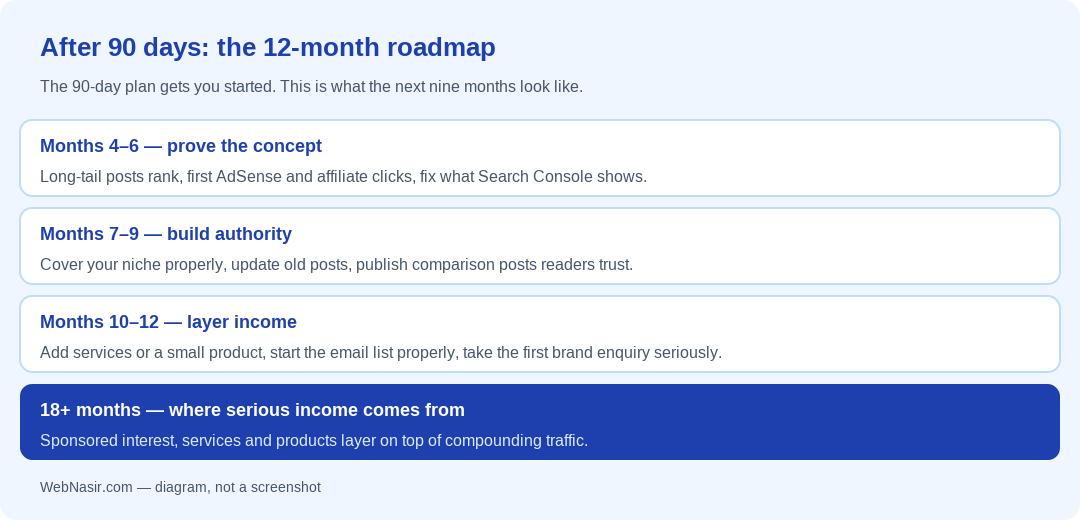
After the first 90 days: a realistic 12-month roadmap
Months four to six are the proof-of-concept phase from the original timeline: long-tail posts start to rank, the first AdSense and affiliate clicks arrive, and income stays small and irregular. Your job in these months is to keep publishing and to start listening to the data. Search Console will show which posts are getting impressions — those are the topics to write more about. It will also show which posts get clicks but lose readers quickly, which usually means the post did not deliver what its title promised. Fix those posts first, before writing new ones. By the end of month six you should know, from evidence rather than hope, which topics your readers actually want and which of your posts they actually read.
Months seven to nine are the authority phase: cover your niche properly, update your old posts, and publish the comparison posts that readers trust. This is the period where the blog stops being a collection of posts and starts being a resource — a place a reader can find everything they need on one subject. It is also when your first service enquiries or freelance offers may arrive, because your posts have been public long enough for someone to have read several of them and decided you know what you are talking about. Respond to every genuine enquiry properly, even if you cannot take the work, because a polite, helpful reply is itself a reputation. Keep the email list growing with one useful email a week, and keep the publishing rhythm steady rather than heroic — consistency beats bursts.
Months ten to twelve are when the income layers start to stack. AdSense and affiliate income, still modest, become regular rather than occasional. Services or freelance writing, if you pursued them, provide the cash flow that ads cannot yet match. A small digital product, validated by your readers and built on a problem you have answered many times, can add a third stream. And the first brand enquiry may arrive — take it seriously, scope it in writing, label it clearly, and do it well, because it becomes the proof for the next one. None of this is guaranteed, and this guide will not promise it: the timeline depends on publishing consistently, in a niche that pays, for a full year. But a blog that reaches month twelve with twenty or thirty useful posts, a growing list, and three income methods attempted is a blog that has earned the right to expect the 18-month phase the original timeline describes — where sponsored interest, services, and products layer on top of traffic that finally compounds.
The 9 methods at a glance
| Method | First income | What it needs most | Best for |
|---|---|---|---|
| Google AdSense | Slow — needs traffic first | Useful posts that rank | Patient bloggers in advertiser niches |
| Amazon Associates | Slow to steady | Honest reviews and comparisons | Tech, gadgets and buying guides |
| EarnKaro / Cuelinks | Slow to steady | Deals readers actually want | Indian shopping and festive posts |
| Sponsored posts | Later — needs niche traffic | A focused, trusted audience | Blogs with a clear readership |
| Your own services | Fastest for most blogs | A skill your niche needs | Designers, tutors, consultants |
| Digital products | After trust is built | A problem readers ask about | Bloggers with an engaged list |
| Email list + offers | Builds over months | One useful email a week | Every blog, started early |
| Freelance writing | Fast — portfolio is public | Good published posts | Writers who want clients soon |
| Second site / flipping | Advanced — only after the rest work | A first site that already earns | Experienced bloggers only |
Frequently asked questions
How long does it take to earn money from a blog in India? The honest answer is the timeline at the top of this guide: months 1–3 usually earn almost nothing, months 4–8 bring small, irregular income, months 9–18 are where real earnings become possible if you published consistently, and 18 months onward is where most serious Indian bloggers' income actually comes from. Anyone promising faster results is selling a course, not describing blogging. The bloggers who earn are the ones who were still publishing in month nine.
Can I start a blog in India for free? Yes — the ₹0 route in this guide is Blogger, which costs nothing and is fine for learning. The serious route is WordPress on budget hosting with your own domain, where your real costs are domain plus hosting, plus GST where applicable. Either way, be wary of anyone selling you an expensive blogging setup before you have traffic: the money should go into the blog only after the blog has shown it can attract readers.
Do I need a lot of traffic to earn from AdSense? You need real, growing traffic from readers who came with intent — but there is no single visitor number that guarantees income, and this guide will not invent one. What matters is the niche, the quality of the posts, and whether readers stay and engage. A small blog in a niche advertisers compete for can earn more than a large blog in a niche nobody pays to reach. Focus on the niche and the content first, and let the traffic follow.
Is blog income taxable in India? Yes — blog income is taxable income, and you should keep invoices, AdSense payment records, and affiliate statements in one folder from day one. AdSense pays to your bank after you cross its payment threshold and complete tax and identity verification. As income grows, talk to a CA about GST applicability and TDS on sponsored and affiliate payments rather than guessing once money is regular.
Which method should I start with? Start with the combination this guide recommends: publish useful posts in a niche that pays, apply for AdSense in the 61–90 day window, join Amazon Associates and EarnKaro, and start an email list. In parallel, offer a service your niche needs if you have the skill — services are the fastest money for most small blogs, and they fund the months while advertising income is still growing. The mistake is chasing all nine methods at once; the right move is two or three, done properly, for a full year.