Freelancing · India · Beginners
How to Start Freelancing in India in 2027: A Beginner's Step-by-Step Guide
Freelancing is not “sign up and get clients”. It is a small business with one employee — you. This guide is how to start freelancing in India for beginners, in the order that actually works: skill first, proof second, profiles third, clients fourth. Skip the order and you join the crowd bidding ₹500 on everything with no replies.
Step 1 — Pick one in-demand skill
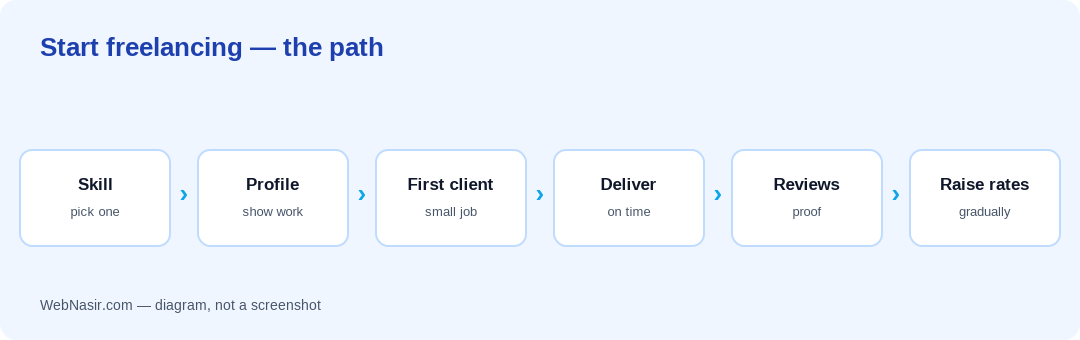
Choose one to start: AI automation, web development, design, writing, or video editing are the five with steady demand in our research. One skill, clearly stated (“I build WordPress sites for coaching institutes”) beats “I do everything” every time. You can add skills after the first paying clients.
Step 2 — Learn fast with free resources
YouTube, Coursera audit/free courses and official docs are enough to start. Learn in public: build while you watch, do not collect courses. Two focused weeks on projects beats two months of tutorials with nothing to show.
Step 3 — Build a portfolio with 3–5 samples (before any client)
- Make sample projects for imaginary-but-realistic clients in your niche.
- Show the problem → your work → the result, not just screenshots.
- Host it free using Guide #4's ₹0 route — your portfolio site is itself a sample.
Build your portfolio site free →
Step 4 — Set up profiles that sell: Upwork, Fiverr, LinkedIn
- Headline = outcome + niche , not “Freelancer | Hardworking”.
- First paragraph: who you help, what you deliver, proof (samples).
- LinkedIn matters for Indian B2B clients — post your samples and process weekly.
Step 5 — Pricing: fair start, then project pricing
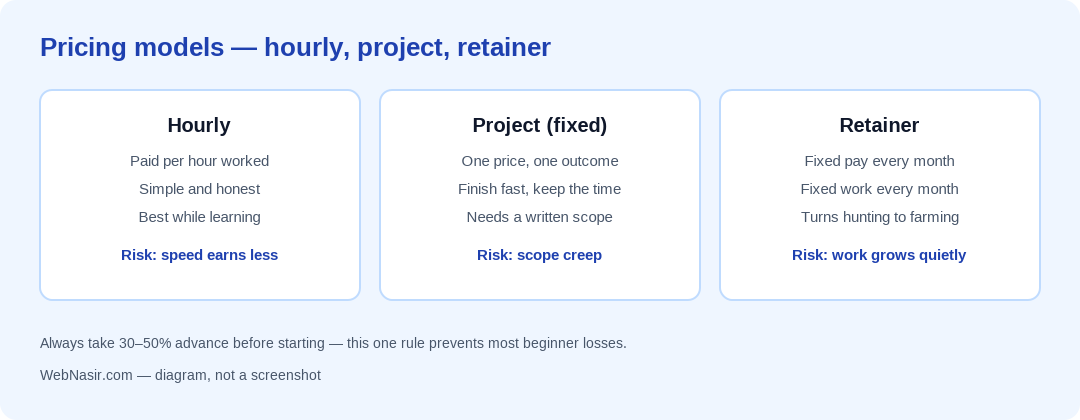
Research what your niche charges, start fair (not cheapest — cheapest signals risk), and move from hourly to project pricing as soon as you can estimate work. Always take 30–50% advance before starting — this one rule prevents most beginner losses.
Step 6 — Land first clients
- Write proposals that open with the client's problem and your specific plan — never copy-paste blasts.
- Daily outreach: a small number of well-researched applications beats 50 generic ones.
- Use warm networks first: local businesses with bad/no websites are visible proof you can help.
- Deliver early, communicate daily, ask for a testimonial + referral on delivery day.
Step 7 — Money & tax basics
Keep a separate bank account for freelance income, invoice every job (even small ones), and save records of platform payouts and TDS certificates. Register for GST when you cross the applicable threshold or when clients/platforms require it — and take a CA's advice once income is regular rather than guessing. Platforms deduct fees/TDS in different ways; read your payout statement, not just the headline amount.
Pair freelancing with a blog
Freelancing pays this month; a blog compounds for years. Our blogging guide shows how services from a blog often become its biggest earner — run both plays together.
How to earn money from a blog in India →
Course path: this guide is the free roadmap for WebNasir's freelancing course direction — work through Steps 1–4 this week before buying any course, anywhere.
Choose a niche before you choose a platform
Most beginners do this backwards. They create an Upwork profile first, then stare at the skills box wondering what to type, then list six unrelated skills and hope something sticks. Clients do the opposite: they search for one specific problem — “someone who can fix my Shopify checkout”, “someone who can edit my YouTube videos this week” — and they hire the profile that looks like it was built for exactly that job. A niche is not a life sentence. It is a door. You pick one door, walk through it, get paid, and then you can open others. But without a door, you are standing in a corridor with a thousand other beginners shouting “I do everything.”
A workable niche has three parts, and you need all three. First, a skill you can actually deliver — not one you plan to learn after a client pays you. Second, a type of client who has money and a recurring need: coaching institutes that need landing pages every month, YouTubers who need four edits a week, small e-commerce brands that need product photos and listings. Third, a problem you can describe in the client's own words. “I help dentists in Tier-2 cities get appointment bookings from Google” is a niche. “I do digital marketing” is a wish. The narrower version sounds smaller, but it converts far better, because the client reading it thinks: this person has done this before, for someone like me.
Test a niche for one week before you commit to it. Spend two evenings reading job posts on Upwork and Fiverr in that niche — not to apply, just to read. What words do clients repeat? What do they complain about with past freelancers? What do they ask for in the first line? Then spend three evenings building one sample that answers the most common request you saw. If you cannot find ten recent job posts in a niche, or you cannot bring yourself to build the sample, that is useful information: either the demand is thin, or you do not actually enjoy the work. Both are good reasons to pick a different door. Enjoyment matters more than beginners think, because freelancing is mostly doing the same kind of work, for similar clients, week after week.
- Can you name five real businesses or creators who would pay for this, today?
- Can you finish a small job in this skill in a few days, without learning it from zero?
- Does the work repeat — will the same client need it again next month?
- Can you show the result in a screenshot, a link, or a 30-second video?
- Would you still do it on a bad week, when you are tired and the client is slow to reply?
If a niche passes four of those five questions, take it. You can always widen later: the web developer who starts with WordPress sites for coaching institutes can add landing pages, then funnels, then full sites for other industries. The video editor who starts with YouTube talking-head edits can add Reels, then ads, then full channel packages. The order matters — depth first, then breadth. Clients pay for depth. They pay a premium when they believe you have solved their exact problem ten times already, and they discount you when they suspect you are figuring it out on their project. Your first niche is how you earn the right to charge more, and the proof you collect inside it is what lets you move into the next one.
The skills Indian clients actually pay for in 2027
Demand shifts every year, but the pattern underneath it is stable: clients pay for work that either brings them money or saves them time. A website that takes bookings brings money. An automation that answers common customer questions saves time. A video that keeps viewers watching brings money. A clean set of accounts saves time. If you learn a skill, ask which of those two it does, and for whom. A skill that does neither is a hobby, and hobbies are fine — they just do not pay rent. The five skill areas below are the ones where Indian beginners most often find their first paying work, because the clients are easy to find and the first jobs are small enough to finish in days, not months.
Web development is the most forgiving starting point if you like building things. The first jobs are rarely “build a web app from scratch”. They are: fix this WordPress site, make a landing page for a new course, connect a payment button, speed up a slow site, move a site to a new host. Each of those is a real job a real business will pay for, and each one teaches you something the next client will ask for. AI automation is newer and noisier: clients ask for chatbots, for connecting their forms to WhatsApp, for sorting their emails or invoices automatically. The tools change fast, so what matters is not knowing one tool perfectly but being able to take a messy manual process, break it into steps, and automate the boring parts without breaking the rest. Design and writing are the oldest freelance skills and still the most crowded — which means the work is there, but standing out takes proof, not promises. A designer with ten clean samples beats a designer with a long list of software names. A writer with three published-style samples beats a writer with a degree and no links.
Video editing deserves a special mention for Indian beginners, because the demand is visible everywhere: every YouTuber, coach, restaurant, and local brand wants short video, and most of them cannot edit it themselves. The first jobs are small — cut a 20-minute recording into a tight 8-minute video, add captions, pick the best 30 seconds for a Reel. The tools are free to start with: CapCut on desktop, DaVinci Resolve for serious work, both free at the level a beginner needs. The skill that actually gets you rehired is not fancy effects; it is judgement — knowing what to cut, where the boring part starts, and when a caption helps instead of distracting. Watch the first ten seconds of your own edit as if you were a stranger scrolling past it. If you would keep watching, the client will too.
| Skill area | Typical first jobs | What proves you can do it | Free place to start learning |
|---|---|---|---|
| Web development | Fix a WordPress site, build a landing page, connect a payment button | Two live sites a client can open on their phone | freeCodeCamp, YouTube tutorials, official WordPress docs |
| AI automation | Chatbot for a business, form-to-WhatsApp flow, invoice sorting | A short screen recording of the automation working end to end | Official docs of the automation tool, YouTube walkthroughs |
| Design | Logo refresh, Instagram posts, pitch deck, menu or flyer | Ten clean samples in one style, shown as real mockups | Figma free tier, Canva free tier, YouTube design channels |
| Writing | Blog posts, product descriptions, website copy, video scripts | Three samples written for a real type of business, with headlines | Reading good blogs in your niche, free writing courses, practice |
| Video editing | YouTube edits, Reels, captions, trimming long recordings | Three before-and-after edits, each under a minute to judge | CapCut free, DaVinci Resolve free, YouTube editing tutorials |
Learn free: a 30-day plan that ends with samples, not certificates
Beginners collect certificates; clients collect proof. A certificate says you finished a course. A sample says you can do the work. Nobody hiring a freelancer has ever said “show me your certificates first.” They say “show me something like what I need.” So treat learning as a means to samples, not as the goal itself. The plan below fits around a job or college: about two focused hours a day, for thirty days. It is deliberately boring. Boring is what works — the same small actions, repeated daily, beat a heroic weekend followed by three weeks of nothing.
In the first ten days, pick one skill and one tool, and learn by copying real work. If you chose web development, rebuild the homepage of a local business you know — better, faster, cleaner — without telling them yet. If you chose video editing, take a public-domain or Creative Commons video and cut it into a 60-second Reel with captions. Copying teaches faster than watching, because your hands find the gaps your eyes missed. Watch a tutorial only when you are stuck on a specific step, then go back to building immediately. Two focused weeks of building beats two months of tutorials with nothing to show, and the gap shows in your portfolio on day one.
- Days 1–10: Learn by copying. One skill, one tool, one small rebuild or edit every two days. Keep notes on what confused you — those notes become your FAQ answers later.
- Days 11–20: Build three samples for imaginary-but-realistic clients in your niche. A coaching institute landing page, a Reel for a restaurant, a chatbot for a clinic. Treat each like a paid job: brief, deadline, delivery.
- Days 21–25: Package the samples. Put them on a simple portfolio site or a public Google Drive folder with a one-line description each: the problem, what you did, the result.
- Days 26–30: Set up one platform profile properly and send your first five careful applications. Not fifty — five, each written for one specific job you actually read.
Two rules make this plan work. First, finish things. An unfinished landing page teaches you nothing and proves nothing; a finished, slightly rough one teaches you the whole job — starting, getting stuck, fixing, delivering. Second, keep a simple log: date, what you built, what broke, how you fixed it. After thirty days that log is a goldmine. It tells you which jobs you enjoy, which ones take too long, and what to charge. It also becomes the raw material for your LinkedIn posts and your proposal answers, because clients trust freelancers who can describe real problems they solved, in plain language, more than freelancers who list tools. The log is also your defence against the most common beginner feeling — that you have learned nothing. Read week one again on day thirty and the progress is obvious.
Build a portfolio that wins work without any clients yet
The classic beginner trap is waiting: “I need clients to build a portfolio, and I need a portfolio to get clients.” Break it by building for imaginary clients who look exactly like real ones. Pick three real types of businesses in your city or niche — a coaching institute, a dental clinic, a home baker who sells on Instagram — and make the thing each one needs. A landing page for the coaching institute's new batch. A price list and appointment page for the clinic. A week of Instagram posts for the baker. Nobody needs to hire you for these to exist, and when a real client in the same niche sees them, the reaction is “she has done this before” — which is the whole point of a portfolio.
Each sample needs three things, in this order: the problem, your work, the result. The problem is one or two lines in plain words — “the coaching institute's old site took 12 seconds to load on a phone and the admission form did not work.” Your work is what you actually did — “rebuilt it as a single fast page with the batch timings, fees, and a WhatsApp button at the top.” The result is what changed, stated honestly — “loads in under two seconds on mobile data, and the form can be tested in ten seconds.” Do not invent numbers you did not measure. If you did not measure a result, say what the sample demonstrates instead: “shows the full admission flow a parent would follow.” Honesty here is not just ethics; it is strategy. A client who catches one invented number will doubt everything else on the page.
Host the portfolio where a client can open it on their phone in under ten seconds, with no login and no download. A simple one-page site is best — your portfolio site is itself a sample of your work, which is why this guide's earlier step pointed you to the free route in Guide #4. If you are not a web person, a tidy public folder with clear file names and a short document explaining each sample also works. What does not work is a zip file, a folder of files named “final-final-v2.jpg”, or a portfolio that only opens on a laptop. Clients browse on phones, between other tasks. They give you about fifteen seconds. Put your best sample first, your name and what you do in one line at the top, and a way to contact you that does not require them to create an account anywhere.

Update the portfolio the day you finish real work, while the details are fresh. Replace your weakest imaginary sample with the real job, add one line from the client's feedback if they gave permission, and link to the live result wherever possible. A portfolio is not a monument you build once; it is a shelf you keep restocking. The freelancers who get hired repeatedly are rarely the most talented in the room — they are the ones whose portfolio answers the client's next question before it is asked. Keep it to your best five to seven pieces. Ten mediocre samples dilute the three great ones, and clients remember the weakest thing they saw, not the strongest.
Upwork vs Fiverr vs LinkedIn vs direct clients
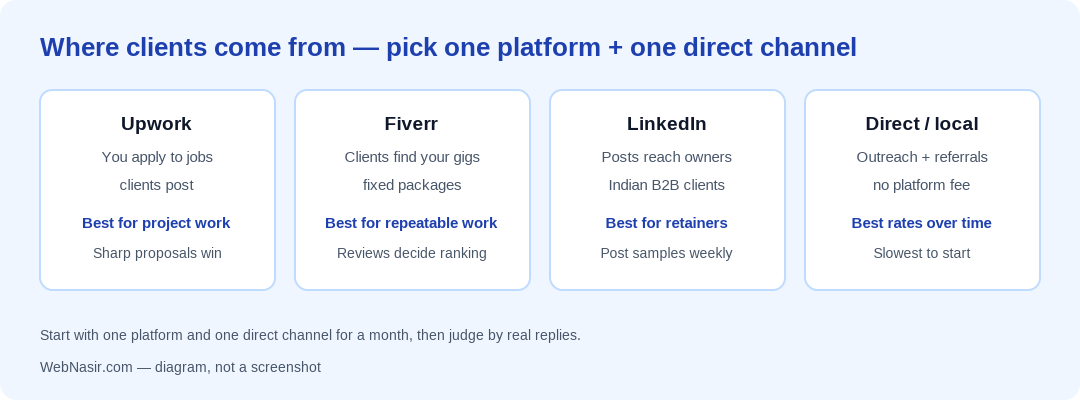
Beginners argue about which platform is “best” as if there is one answer. There is not. The platforms do different jobs, and the right choice depends on what you sell and how you like to work. Upwork is a marketplace where clients post jobs and freelancers apply: good if you can write a sharp proposal and you like choosing your work. Fiverr is a shop where you list fixed services (“gigs”) and clients come to you: good if your work fits a clear package with a clear price, like “I will edit one YouTube video” or “I will design three Instagram posts.” LinkedIn is not a marketplace at all; it is where Indian business owners actually hang out, and where a post showing your work can reach the person who signs the cheque. Direct clients — local businesses, referrals, people you meet — pay the best rates over time and charge no platform fee, but they take the longest to find.
The honest way to choose is to start with one platform and one direct channel, not all four at once. If your work is project-shaped and you are good at writing, start with Upwork plus LinkedIn posts showing your samples. If your work is package-shaped and repeatable, start with Fiverr plus outreach to local businesses. Run that pair for a month and look at the evidence: where did the replies come from, which conversations went furthest, what did people actually ask for? Then double down on what worked. Spreading yourself across four platforms with half-finished profiles is the most common way to conclude that “freelancing doesn't work in India” — when what didn't work was the setup, not the market.
| Route | How work finds you | Best for | Watch out for |
|---|---|---|---|
| Upwork | You apply to jobs clients post | Project work, custom jobs, long-term clients | You spend Connects to apply; read each job fully before applying |
| Fiverr | Clients find your listed gigs | Fixed, repeatable packages with a clear deliverable | Standing out needs reviews; keep gigs narrow and specific |
| Posts and messages reach business owners | Indian B2B clients, retainers, referrals | Results come from posting samples weekly, not from a profile alone | |
| Direct / local | Outreach, referrals, word of mouth | Best rates, no platform fee, repeat work | You handle contracts, advances and follow-ups yourself |
Setting up your Upwork profile, step by step
Your Upwork profile is a sales page, not a CV. Nobody hires a CV; they hire a person who looks like the answer to their problem. Start with the photo: a clear, recent, front-facing photo of you, in decent light, looking like someone a client would trust on a video call. Not a logo, not a group photo, not a ten-year-old picture. Then the headline. The formula that works is outcome plus niche: “WordPress developer for coaching institutes” or “Video editor for YouTube educators.” Compare that with “Freelancer | Hardworking | Available 24x7” — the second one says nothing a client can use, and every beginner writes some version of it. Your headline is the one line a client reads in search results. Spend an hour on it if you have to.
The first two lines of your overview matter more than the rest of the page, because that is all a client sees before clicking “more”. Open with who you help and what you deliver: “I build fast WordPress sites for coaching institutes — batch pages, fee details, and a WhatsApp button parents can actually find.” Then prove it: link your two best samples, name the result in plain words, and say how you work — reply within a few hours, daily updates, delivery on the date promised. End with a simple next step: “Send me your current site link and I will tell you the three things I would fix first.” That last line does real work: it gives the client an easy, low-risk way to start a conversation, and it filters for clients who are serious enough to reply.
Fill in the rest properly, once, instead of rushing it. Skills: list the ones you can actually deliver, not every tool you have opened once. Employment history: your real experience, even if it is a job, an internship, or college projects — honesty beats a padded history every time, because clients check. Portfolio: the samples you built in the 30-day plan, each with the problem, your work, and the result. Rate: set a fair starting rate you can defend, not the lowest you can imagine — the cheapest profile signals risk, not value, and the clients who pick the cheapest freelancer are the ones most likely to disappear, demand endless revisions, and leave a bad review anyway. Finally, take the readiness checks and identity verification the platform asks for. A verified profile with a complete overview gets seen; an empty one does not, however talented the person behind it is.
Setting up Fiverr gigs that get found
Fiverr works differently from Upwork, so the setup is different too. On Upwork you chase jobs; on Fiverr, jobs chase you — but only if your gig matches what buyers actually type into the search box. That means the gig title should use the buyer's words, not yours. Buyers search for “edit my YouTube video”, “design a logo for my bakery”, “build a landing page for my course”. They do not search for “professional creative solutions provider”. Write the title the way a tired business owner would type it at 11 pm. Then make the gig narrow: one service, one deliverable, one clear price structure. “I will edit one YouTube video up to 10 minutes with captions” will outsell “I will do video editing” every time, because the buyer knows exactly what they get.
The gig image is your shop window. Use a real frame from your sample work, with a short label of what it is — not a wall of text, not a stock photo, not a screenshot of your editing software. The description should answer the three questions every buyer has: what exactly do I get, how long does it take, and what do you need from me to start? List the deliverables plainly — number of revisions, file formats, delivery time — and say what is not included, because the arguments that ruin new sellers almost always start with “I thought this was included.” Set the delivery time you can actually meet on a bad week, not your best day. A gig delivered a day early earns a five-star review; a gig delivered a day late earns a story the buyer tells other buyers.
Start with one gig, done properly, and add more only after the first one has a review or two. New sellers are tempted to publish eight gigs in a weekend; the result is eight thin listings that all look the same. One strong gig with real samples, clear pricing, and honest delivery times will teach you more about what buyers want than eight guesses. When orders come, over-deliver slightly on the first few — a small extra, a faster turnaround, a short note explaining what you did and why. Early reviews are the currency of Fiverr; they decide whether your gig shows up on page one or page nine. And reply to every message fast, even if the reply is “I need two hours to check this properly.” Speed of response is one of the few things a new seller can fully control, and buyers notice it.
Finding clients outside platforms: LinkedIn, local businesses, referrals
Platforms are the easiest place to start, but they are not the only place, and over time they should not be the main place. The reason is simple arithmetic: on a platform, you compete with every freelancer in the world who saw the same job post. Off the platform, you compete with whoever the client already knows — which, for a local coaching institute or a small brand, is often nobody. The best first clients for Indian beginners are frequently within a few kilometres: the coaching centre with a website last updated in 2019, the restaurant with a beautiful dining room and a dead Instagram page, the clinic whose Google listing has the wrong phone number. These businesses have the problem, they have the money, and nobody has offered to fix it.
Outreach to a local business works when it is specific, short, and about them. Walk in or message with one observation and one offer: “I noticed your admission form doesn't open on a phone. I rebuilt a version that does — here is the link, you can test it in ten seconds. If you like it, I can put it live this week.” That is a completely different message from “Dear Sir/Madam, I am a freelancer offering web development services.” The first one shows work; the second one asks for trust you have not earned. Do the sample first, then make contact. The sample costs you an evening; the reply rate is many times higher, because you have removed the client's biggest fear — paying someone who might not deliver. And if they say no, you still have a portfolio sample and you learned something about their real needs.
LinkedIn deserves the same approach, posted in public instead of sent in private. Once a week, post one thing you actually did: a before-and-after screenshot, a 30-second screen recording of an automation, a short note about a problem you solved and how. Write it in plain language, tag nobody, sell nothing. The audience is not “everyone on LinkedIn” — it is the handful of business owners and managers in your niche who will see it over the next few months and remember your name when they need the work. Most beginners post once, get three likes, and quit. The ones who get clients from LinkedIn post weekly for months. It is slow, unglamorous, and it compounds: every post is a sample that stays visible, and every comment is a small conversation with a potential client. Keep your profile consistent with your posts — same niche, same headline, same samples — so that when someone clicks through, the story matches.
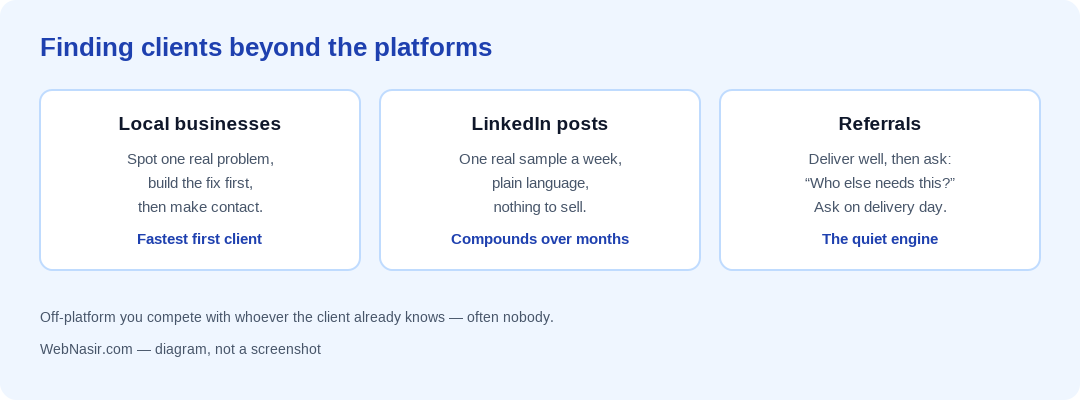
Referrals are the quiet engine of a freelance career, and they start on delivery day, not a year later. When you finish a job well, ask two questions before you close the chat: “Is there anything about the delivery you would like changed?” and, once they are happy, “Do you know one other business like yours who needs this?” Most clients will say yes to the second question if the first answer was good — not because they owe you, but because recommending a good freelancer makes them look good to their friend. Keep a simple list of every client, what you did, and who referred whom. After a year, that list is your business: the freelancers who survive are the ones whose past clients keep sending the next ones. Treat every small job as if the next three jobs depend on it, because very often, they do.
How to write proposals clients actually read
A client posting a job on Upwork receives dozens of proposals. Most are deleted in seconds, and the reasons are always the same: they open with the freelancer's life story, they say “I am interested in your project” without mentioning the project, or they are clearly copy-pasted — the wrong name, the wrong platform, the wrong skill. The proposals that get read follow a simple shape: first line about the client's problem, second part about your specific plan, third part proof, and a question at the end. “Your checkout drops customers on mobile — I checked it on my phone and the payment button is cut off below the fold. I would rebuild that section first, test it on two phones, and have it live by Thursday. I did the same fix for a coaching site last month; here is the link. Can you tell me which payment gateway you use?” A client who reads that knows you opened their site, you have a plan, and you have done it before.
The proof you attach matters more than the adjectives you use. “I am hardworking, dedicated, and passionate” tells the client nothing; a link to a sample that looks like their job tells them everything. If you have no directly matching sample, attach the closest one and say so honestly: “I haven't built a checkout for a jewellery store, but here is a payment flow I built for a course site — same gateway, same mobile problem.” Clients respect that sentence far more than a freelancer who claims to have done everything. Keep proposals short: five to eight lines is enough for most jobs. The client is not hiring an essay; they are hiring a person who understands the job. End with one question that moves the conversation forward — about their timeline, their tools, or what “done” looks like — because a proposal that ends with a question is far more likely to get a reply than one that ends with “looking forward to hearing from you.”
Apply to fewer jobs, better. Ten careful applications a week will beat fifty generic ones, and it will teach you faster, because you will actually read the replies and learn what clients respond to. Before you apply, read the whole job post twice: once for what they want, once for what they are worried about. The worry is usually between the lines — “need someone reliable this time” means the last freelancer disappeared; “must communicate daily” means the last one went silent for a week. Address the worry directly: “I reply within a few hours and send a short update every evening.” That one line can matter more than your skills list, because the client has already decided the skill is learnable — what they are really buying is someone who will not vanish. Track your applications in a simple sheet: job, date, what you wrote, reply or not. After a month, the pattern is visible, and you can fix what is not working instead of guessing.
Pricing your work: hourly vs project vs retainer
Pricing is where beginners lose the most money, usually by being cheap. The logic feels safe — “if I charge less, more people will hire me” — but it works backwards in practice. A very low price tells a client you are either desperate or inexperienced, and it attracts the clients who want the most work for the least money, argue about every revision, and pay late. A fair price, stated confidently, attracts clients who value the work and respect your time. “Fair” does not mean high; it means priced for the value and the market you are in. Research what your niche charges by reading job posts, asking other freelancers, and looking at what agencies in your city quote for the same work. Then set a starting rate you can defend out loud without apologising for it.
Hourly pricing is honest and simple, and it is the right choice while you are learning how long things take. The risk is that you get faster — and then you earn less for the same work, which punishes you for improving. Project pricing fixes that: you quote one price for one defined outcome — “a five-page website with booking form, delivered in seven days” — and if you finish in four days, the extra time is yours. The catch is that project pricing only works when the scope is written down: what is included, how many revisions, what happens if the client adds pages halfway through. Without a written scope, a project price becomes an unlimited hourly job in disguise. Retainers are the third model and the goal for most freelancers: a client pays a fixed amount every month for a fixed amount of work — four videos a month, ten social posts, site maintenance and updates. Retainers turn freelancing from hunting into farming: you know what next month pays, and you can plan.
| Model | How you get paid | Best when | Risk to watch |
|---|---|---|---|
| Hourly | Per hour worked, tracked on the platform or by agreement | You are still learning how long jobs take | Getting faster earns you less for the same job |
| Project (fixed) | One price for one defined outcome | The scope is clear and written down | Scope creep: extra work with no extra pay |
| Retainer | Fixed amount every month for fixed work | The client needs the same work every month | Work growing quietly beyond the agreed amount |
| Value / package | One price for a bundle with a clear result | The outcome is worth far more than the hours | Promising results you cannot control |
Raise your rates in small steps, tied to proof, not to hope. After your first five completed jobs with good feedback, raise by a little. After you have a repeat client, raise again. After you can show a result — a site that takes bookings, a channel that grew, a process that saves hours — raise again. Tell existing clients before the change, with notice and a reason: “From next month my rate for new projects is X, because the work now includes Y.” Most good clients accept a fair rise from someone who delivers; the ones who leave over a small rise were never going to pay you properly anyway. And never let a client set your price by telling you what the last freelancer charged. The last freelancer's price is not your price — they had different skills, different costs, and, very often, they quit, which is why the job is open.
One pricing rule saves more beginners than any other: take an advance. Thirty to fifty percent before you start, as this guide said in Step 5, and the balance on delivery — or in milestones for bigger jobs, with a payment at each milestone before the next stage begins. An advance does three things: it proves the client is serious, it covers your time if they go quiet, and it changes the relationship — you are now working with a client, not auditioning for one. If a client refuses any advance at all, treat that as information, not as a negotiation to win. Serious clients understand advances; they pay them to agencies and to other freelancers every day. The ones who refuse are often the ones who will also be slow to pay the balance, and you will have spent the month chasing them instead of finding better work.
Getting paid: PayPal, Payoneer, Wise and UPI
Getting paid across borders is the part of freelancing that worries Indian beginners the most, and it is also the part with the most outdated advice floating around. The practical picture is this: domestic clients pay you in rupees, usually by UPI or bank transfer, and that is the simplest route — fast, free for most personal transfers, and easy to track. International clients pay through a platform or a payment service, and the money reaches your Indian bank account in rupees after the service takes its fee and applies its exchange rate. The four names you will meet most often are PayPal, Payoneer, Wise, and UPI for domestic work. They are not interchangeable: they differ in fees, in how fast the money arrives, in what paperwork they ask for, and in which platforms they connect to. Do not pick one because a YouTuber recommended it; pick the one that fits the client and the platform you are actually using.
Platform work is the simplest to get paid for, because the platform holds the client's money and releases it when the work is approved. On Upwork, clients fund milestones or hourly contracts and the platform releases payment on its schedule; on Fiverr, the buyer pays upfront and the money clears after delivery. For direct international clients, you need your own route. PayPal is the most widely recognised — almost every foreign client has heard of it and many already have an account — but check its current fee page before you quote a price, because the fee and the exchange rate both affect what you actually receive. Payoneer is popular with freelancers because it connects to many marketplaces and gives you receiving accounts for foreign currencies. Wise is often used for direct bank-to-bank transfers because its exchange rate is usually close to the mid-market rate — again, check the current fee page for the exact cost on your route before you promise a client a price.
| Route | Best for | How the money reaches you | Check before you use it |
|---|---|---|---|
| UPI / bank transfer | Indian clients, domestic work | Directly to your bank account in rupees | Keep the client's name and invoice number in the transfer note |
| PayPal | Direct foreign clients who already use it | To your linked Indian bank account | Current fee page and exchange rate; withdrawal rules for India |
| Payoneer | Marketplace payouts and foreign clients | To your bank account, or to the Payoneer card where available | Which marketplaces it connects to, and the withdrawal fee |
| Wise | Direct foreign bank transfers | To your bank account at a rate close to mid-market | Current fee for your currency route and transfer time |
| Platform payout | Upwork / Fiverr jobs | Platform releases funds to your chosen payout method | The platform's payout schedule and minimum withdrawal |

Whatever route you use, keep the paperwork from day one. Every payment should be traceable to an invoice, a client, and a job: invoice number, date, client name, what was delivered, amount, and how it was paid. For foreign payments, your bank may ask for a Foreign Inward Remittance Certificate — a FIRC — which is the document that proves money came from abroad for services. You can usually request it from your bank after the payment arrives; ask your bank what they need before you need it urgently, not after a client is waiting. Keep screenshots or PDFs of platform payout statements too, because they are the record that the money came through a marketplace and not from somewhere unexplained. This sounds like boring admin, and it is — but it is the admin that makes tax time a one-day job instead of a one-month panic, and it is what a chartered accountant will ask for first.
A few payment habits protect you from the most common losses. First, never start significant work without an advance or a funded milestone — the platforms exist partly to solve this, so use them while you are new. Second, never accept payment in gift cards, cryptocurrency from a stranger, or “I will pay you after my client pays me.” Those are not payment methods; they are ways to work for free. Third, quote prices that already account for fees: if a service takes a cut, the cut comes out of your price, not out of your rent. Work out what you actually receive per job after fees and exchange rates, and write it down. Fourth, keep freelance money in a separate bank account from your personal spending, as Step 7 said. When the money is mixed, you cannot tell whether freelancing is paying, and you cannot prove your income when you need to — for a loan, a visa, or a tax filing.
Taxes, GST and paperwork for Indian freelancers
Tax is the topic beginners avoid longest, and avoiding it is what makes it expensive. The basics are not complicated, but they are specific to India, and getting them wrong costs more than getting them right costs in time. First, freelance income is income: it goes on your income tax return, under the head that fits how you work — usually business or profession, or other sources for small, occasional work. Keep every invoice and every payout statement, because your return is built from those records. Second, clients and platforms may deduct TDS — tax deducted at source — before they pay you. That is not a loss: TDS is tax already paid on your behalf, and it shows up in your Form 26AS and Annual Information Statement on the income tax portal. Check those statements once a quarter so that what clients deducted matches what the portal shows, and keep the TDS certificates clients give you.
GST is the question every Indian freelancer asks, and the answer is simpler than the rumours suggest. GST registration for freelancers is required only above ₹20 lakh of annual revenue — that threshold is the one that applies to most service providers, and it is the figure confirmed on Google's own business pages for Indian sellers. Below that, you generally do not need to register, and you do not charge GST on your invoices. But there are exceptions that matter: if you sell services to clients outside India, or if a platform or a large client requires you to be GST-registered before they will work with you, the threshold alone does not settle it. And the threshold is about your total revenue across the year, not about one client or one month. Keep a running total of what you invoice each month so you know where you stand before you cross it, not after. When your income becomes regular — not one lucky month, but steady work — sit with a chartered accountant for an hour. A CA will tell you in one meeting whether you need to register, which scheme fits, and what records to keep, and that hour costs far less than a notice you did not expect.

Three documents are worth setting up early, because every serious client and platform will ask for them sooner or later. A PAN card, which you almost certainly have already, is the base of everything tax-related. A separate bank account for freelance income, which keeps your records clean and makes your CA's job — and your own — far easier. And a simple invoice format you reuse for every job: your name, contact, invoice number, date, client name, description of the work, amount, payment details, and your PAN if the client needs it for TDS. Free invoice tools and templates exist, but a clean document you make yourself works just as well. Number your invoices in order, without gaps, and keep a copy of every one. When a client asks “can you send the invoice again?”, you should be able to send it in thirty seconds — that small professionalism is noticed, and it is remembered when the next job comes around.
One more paperwork point that beginners miss: if you work for foreign clients, keep proof of what the work was, not just that money arrived. A short contract or even a clear email thread — what you will deliver, for how much, by when — protects both sides, and it is the document your bank or your CA will want if they ask about a foreign payment. Save the brief, the delivery messages, and the payment confirmation together, per client, in one folder. It takes two minutes per job and it turns a vague memory into a record. Freelancing is a business, and businesses run on records. The freelancers who treat it like one from the first month are the ones who can scale it in the second year — hire help, raise rates, take a loan for equipment — because they can show what they earned and how.
Contracts, advances and protecting yourself
A contract does not need a lawyer or a stamp paper to be useful. For most freelance jobs, a clear written agreement — even an email the client replies “agreed” to — is enough: what you will deliver, by when, for how much, how many revisions are included, and what happens if the client changes the scope halfway through. Write it in plain language, not legal English, because the point is that both of you understand it, not that it impresses a judge. Include the advance, the payment milestones, who owns the work after payment, and how long the client has to ask for changes after delivery. If the client is on a platform, the platform's contract and milestone system already covers most of this — use it, and do not agree to move the conversation and payment off the platform “to save the fee” until you trust the client completely. That suggestion is one of the oldest ways new freelancers lose money.
Scope creep is the slow version of the same problem: the job starts as a five-page website and quietly becomes a five-page website plus a blog, plus a logo, plus “can you just also manage our Instagram?” Each addition sounds small, and saying yes each time feels polite, until you have done two weeks of extra work for the price of one week. The fix is not to refuse — it is to name the extra work and price it: “Happy to add that — it is outside the original scope, so it will be X extra and two more days. Shall I add it to the invoice?” Most reasonable clients say yes, because they expected to pay for more work. The ones who get angry at being asked were planning to get it free, and you have just learned something valuable about them before you did the work, instead of after.
Keep the work itself safe too. Do not hand over source files, passwords, or full admin access before you have been paid — deliver previews, watermarked drafts, or work on the client's own account where they can see progress but you keep the keys until the balance clears. For design and video, send low-resolution previews or watermarked versions for approval, and the final files after payment. For websites, build on a staging link and move it live when the milestone is funded. These are normal professional habits, not suspicion: agencies do exactly the same thing. And back up everything. Keep your project files in two places — your computer and a cloud drive — because a dead laptop the week a client needs a revision is a lost client, and a lost client at the start of your career costs far more than the price of a backup.
Handling difficult clients and scope creep without burning out
Every freelancer meets a difficult client eventually — the one who replies at midnight, changes the brief daily, or goes silent for two weeks and then wants everything tomorrow. The first time it happens, it feels personal. It usually is not. The client is often under pressure from their own boss, or they do not know how to describe what they want, so they describe it five different ways and hope one of them lands. Your job is to make the unclear clear, in writing, before you do more work. After a confusing call, send a short summary: “Just confirming — we agreed on X, by Friday, with two revisions. Reply yes and I will start.” That message prevents most arguments, because it turns a vague conversation into a record both sides can point to. If the client disagrees, you find out now, when it costs nothing, instead of after delivery.
Slow replies need a system, not frustration. State your working hours and your reply time upfront — “I reply within a few working hours, Monday to Saturday” — and then keep to it. When a client goes quiet mid-project, send one polite follow-up after two or three days, then one more a week later, then move on to other work. Do not send five messages in a day, and do not keep a half-finished project blocking your calendar indefinitely. A short line in your agreement helps: “If I do not hear back within seven days, the project pauses and resumes when you reply, and the delivery date moves by the same number of days.” Clients respect boundaries stated calmly at the start; they test boundaries that were never stated. And protect your evenings. Freelancing from home blurs the line between work and life fast, and a client who learns you answer at midnight will keep messaging at midnight. Replying next morning, consistently, trains them better than any announcement.
When a disagreement does happen, keep it in writing, keep it short, and keep it about the work. “The agreed scope was five pages; the blog section is extra, so I have quoted it separately” is a professional sentence. A long emotional message is not, however justified it feels. If a client is rude or threatening, step back: you are allowed to end a working relationship, politely, and keep the advance for the work already done, as your agreement says. On platforms, use the dispute process instead of arguing in chat — it exists for exactly this, and a calm, documented case wins far more often than an angry one. And remember the filter that matters: one bad client is a story; three bad clients in a row is a signal. If every client is difficult, look at your own process — the brief, the pricing, the boundaries — because that is the part you can change.
Growing from first client to steady income
The first client is the hardest. The second is easier, because you have proof. The tenth is easier still, because you have a process. Growth in freelancing rarely looks like a sudden jump; it looks like the same month repeated with slightly better clients, slightly higher rates, and slightly less time spent finding work. The lever that matters most is repeat work. A client who hires you once and never returns costs you the same finding effort as a client who hires you every month — except the monthly one pays you twelve times. So after every job, ask yourself what would make this client come back: a monthly package, a maintenance plan, a next project you can suggest before they ask. “Your site is live — shall I handle the monthly updates and backups for a fixed fee?” is a sentence that turns a one-off job into a retainer, and retainers are what turn freelancing from a hustle into an income.
Niching down further is the second lever, and it feels wrong until you try it. After twenty jobs, you will know which ones you do fastest, enjoy most, and get praised for. Do more of those and fewer of the others. The web developer who discovers she is fastest at landing pages for course creators should say so, everywhere — in her headline, in her samples, in her posts. The market for “landing pages for course creators” is smaller than the market for “web development”, but she can own it, charge more inside it, and get referrals inside it, because every course creator knows other course creators. Generalists compete with the whole world; specialists compete with a handful of people, and they get recommended by name. When you are ready, raise your rate for new clients and keep your best old clients at their old rate for a while — loyalty in one direction earns loyalty in the other.
At some point, you will have more work than hours. That is a good problem, and it has only three honest answers: raise your rates until the work fits your hours, say no to the jobs that fit worst, or bring in help — a fellow freelancer for overflow, an editor, a designer — and take responsibility for their work as if it were your own. Do not take the fourth option, which is saying yes to everything and delivering late everywhere. A freelancer who delivers late loses the reputation that took a year to build, in a month. Track two numbers weekly: hours worked and money received. If the hours keep rising while the money stays flat, your rates or your niche need attention, not your effort. Effort is not the bottleneck anymore; the business model is.
Common mistakes that keep Indian beginners stuck
The mistakes below are not rare — they are the normal beginner experience, and most freelancers make at least three of them in the first year. The difference between the ones who get stuck and the ones who get past it is not talent; it is whether they notice the mistake and change one thing. Read the list honestly, pick the one that sounds most like you, and fix that one first. Fixing one mistake properly is worth more than reading about ten.
- Bidding on everything: fifty generic proposals a week, no replies, and the conclusion that freelancing does not work — when the proposals were the problem.
- Charging the lowest price in the market: attracting the worst clients, earning the least, and having no time left to find better ones.
- Learning forever, delivering never: a folder full of course certificates and an empty portfolio, because starting a real sample felt scarier than watching one more tutorial.
- No advance, no contract: working for a stranger on a promise, then spending a month chasing payment for work already delivered.
- Copying someone else's profile word for word: clients have seen that profile before, and they can tell when the words are not yours.
- Quitting after the first silent month: the first month is slow for almost everyone — the portfolio, the profile, and the first review all take time to compound.
- Ignoring the boring admin: no invoices, no records, mixed bank accounts — and then tax time, a loan application, or a visa form exposes the whole mess at once.
How to start freelancing in India: a realistic first-90-days plan
Ninety days is long enough to build something real and short enough to stay motivated. The plan below assumes two focused hours a day alongside a job or studies. If you have more time, do not do more of everything — do the same things better: better samples, better proposals, better follow-ups. Speed comes from focus, not from hours. And judge the plan by inputs you control — samples finished, proposals sent, posts published — not by outcomes you do not control, like how fast a stranger replies. Inputs compound into outcomes, but only if you keep them up for the full ninety days.
- Days 1–30: Pick a niche, learn by building, finish three samples, set up a simple portfolio. No platform applications yet — the samples come first, because they are what the applications will link to.
- Days 31–60: Set up one platform profile properly and one direct channel — LinkedIn posts or local outreach. Send five careful applications a week. Post one sample or lesson a week. Aim for conversations, not just applications.
- Days 61–90: Deliver the first small jobs brilliantly, collect testimonials on delivery day, and ask every happy client for one referral. Replace imaginary samples with real work. Review your numbers: which channel brought replies, what rate the market accepted, what to raise next.
Expect the first month to feel slow. That is normal, and it is not a verdict on you. A new profile with no reviews is invisible for a while, and the first replies often come from the jobs you least expected — a local business you messaged, a LinkedIn post a friend shared, a small job you almost did not apply for. The freelancers who make it past day ninety are rarely the ones with the most talent on day one; they are the ones who kept the routine when nothing seemed to be happening. Keep the log from the 30-day plan going for the full ninety days. On day ninety, read day one again. The distance between the two is the real measure of the quarter — and it is usually much larger than it felt while you were living it.
Scams targeting new Indian freelancers — and how to spot them
New freelancers are a target, because scammers know you are eager for the first job and unsure what normal looks like. The patterns are consistent, and once you have seen them, they are easy to spot. The most common is the “registration fee” job: a client who loves your profile and asks you to pay a fee — for verification, for a kit, for training — before the work starts. Real clients never ask you to pay them to work for them. Ever. If money flows the wrong way, it is a scam, however professional the website looks. The second pattern is the overpayment trick: a client sends too much money, asks you to return the difference quickly, and the original payment later bounces. Never return money from a payment that has not fully cleared, and never pay a stranger to “release” a payment.
Other patterns are quieter. A client who wants to move the conversation to Telegram or WhatsApp immediately, away from the platform, and pay outside it — sometimes genuine, often the setup for unpaid work, because off the platform you have no dispute process and no payment protection. A “client” who sends you a file to install or a link to log in to — never install software or enter passwords from a stranger's link; real clients share a brief, not an executable file. A job that asks for free work as a “test” — a full logo, a full video, a full website — before any hiring decision: a small paid test is normal, a large unpaid one is free labour, and the “test” often becomes the deliverable they never pay for. And the job that promises big money for no skill and no effort in week one — the same rule this guide's sister articles repeat, because it never stops being true: if it sounds too easy, someone is selling you a dream, not a job.
- Never pay a fee to get a job, be verified, or receive training from a client.
- Never return an overpayment until the original payment has fully cleared in your bank.
- Never install files or click login links sent by a new client.
- Never do a large job as an unpaid test — a small paid test is the honest version.
- Never move payment off a platform with a client you have not worked with before.
- If it promises big money in week one with no skill, walk away — it is a scam or it pays in exposure.
Frequently asked questions
Do I need a degree to start freelancing in India?
No. Clients hire for the work, not for the certificate. They look at your samples, your profile, and how clearly you understand their problem. A degree can help in some fields — a client hiring a legal writer or an accountant may ask about qualifications — but for web development, design, writing, video editing, and automation, your samples are your qualification. What matters is whether you can deliver the job well and on time. If you are a student, say so honestly; many clients like working with students who are sharp, responsive, and fairly priced. Just do not promise skills you do not have yet, and do not let the lack of a degree stop you from starting — the portfolio you build in thirty days will say more about you than any certificate.
How much money do I need to start freelancing?
Very little. You need a phone or a computer, an internet connection, and the tools for your skill — and for the skills in this guide, the starting tools are free: free tiers of design and editing software, free learning resources, free portfolio hosting, and free platform accounts. You do not need a paid course, a new laptop, or a premium subscription to get the first client. Spend money only when a specific job requires it — a tool the client uses, a domain name for your portfolio — and treat it as a business expense with a receipt. The real investment is time: two focused hours a day for a month or two, building samples and learning by doing. That is the cost, and it is also the reason the barrier is low for everyone, including your competition — which is why the samples and the follow-through matter more than the equipment.
Upwork or Fiverr — which should I choose first?
Choose by the shape of your work, not by which one someone else prefers. If your work is custom and project-shaped — a website, an automation, a brand identity — start with Upwork, where you apply to specific jobs with a specific plan. If your work is a clear, repeatable package — one video edit, three social posts, one logo — start with Fiverr, where buyers find your gig and order it. Either way, pair the platform with one direct channel, usually LinkedIn posts or local outreach, so you are not depending on a single source of work. And do not split your first month across both platforms with half-finished profiles. One platform, done properly, plus one direct channel, for thirty days, then judge by the replies you actually got.
Do I need GST registration to freelance in India?
Not at the start, for most beginners. GST registration for freelancers is required only above ₹20 lakh of annual revenue, so if you are just starting out, you are almost certainly below the threshold and do not need to register or charge GST. Keep a running monthly total of what you invoice, so you know when you are approaching it. Two exceptions to check with a CA: if you sell services to clients outside India, the rules can differ, and if a large client or a platform requires GST registration before they work with you, their requirement stands regardless of the threshold. When your income becomes regular, spend an hour with a chartered accountant — it is the cheapest way to get an answer that fits your exact situation, instead of guessing from comment sections.
How do I get my first client with no reviews?
With proof instead of reviews. Reviews are just proof that strangers trust you; samples are proof that you can do the work, and samples are entirely in your control. Build three strong samples for realistic clients, write proposals that open with the client's actual problem, and apply to small jobs where the client cares more about a quick, careful result than about a long history. Local businesses are often the fastest first clients, because they can meet you, see the sample on their own phone, and decide the same day. And price the first jobs fairly, not desperately: a fair price with a clear scope and an advance signals a professional, while the cheapest price signals a risk. One good first job, delivered early with a testimonial, changes everything — the second client sees a review, not an empty profile.
Can I freelance while studying or working a full-time job?
Yes, and most Indian freelancers start exactly that way. The key is honesty about your hours: tell clients when you work and when you reply, and only take jobs whose deadlines fit your real schedule. A small job delivered on time is worth far more than a big job delivered late, so start with small jobs — a few hours each, over a weekend or a few evenings — and grow the workload as you learn how long things actually take. Check your employment contract first if you have a job: some employers restrict outside work or work for competitors, and a quiet side income is not worth a problem at your main job. And keep the boundary: freelancing should fund your goals, not cost you your sleep, your studies, or your day job's performance.
Freelancing in India in 2027 is not a shortcut, and this guide has not pretended it is. It is a real business with one employee, and like any business it rewards the same dull virtues: pick one thing, do it well, show the proof, ask for the advance, deliver on time, and keep the records. The beginners who succeed are not the ones who found a secret platform or a trick proposal. They are the ones who built three good samples, sent five careful applications a week, and were still doing it on day ninety when the first clients started to reply. Start with Step 1 this week — one skill, one niche, one sample — and let the rest of the steps follow in order. The market for honest, reliable freelance work in India is real, and it has room for one more careful beginner: you.