Business Basics · Domains
How to Choose a Domain Name for Your Business: 12 Rules I Give Every Client
By Nasir · WebNasir.com · Updated 26 Nov 2026
Your domain name is the one part of your website you will say out loud — on calls, in your shop, on a printed card — for years. I have watched good businesses pick names that cost them customers every single week: names nobody can spell, names that sound like a different, bigger company, names with a renewal price that ambushes them in year two. These are the twelve rules I walk every client through on how to choose a domain name for your business, before anyone pays a rupee, dollar or pound.
The 12 rules

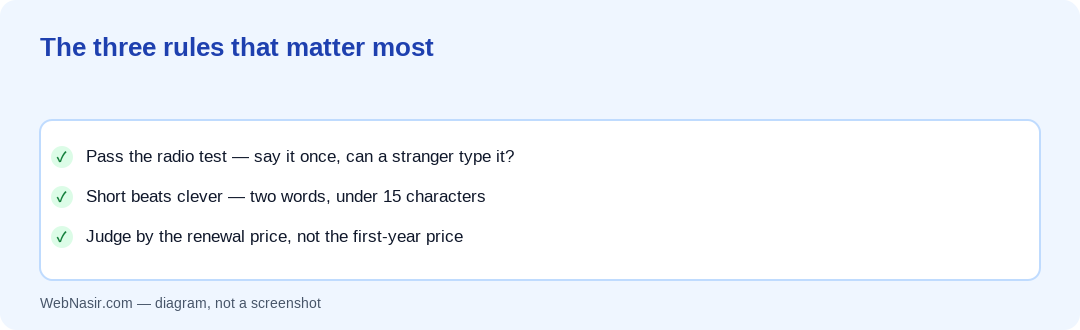
- Pass the radio test. If you say it once on a phone call, can a stranger type it correctly? If you have to spell it, it fails. This one rule eliminates half the clever names people fall in love with.
- Short beats clever. Two words, ideally under 15 characters. Every extra letter is a typo someone else will collect.
- No hyphens, no numbers. “Best-cakes-4-u” forces you to explain the address forever (“with hyphens… the number four…”). Nobody remembers; everybody mistypes.
- Prefer .com — or your country's extension when your customers are local. .com is still the default people guess. A local business serving one country is well served by .in (India), .co.uk (UK) or .ca (Canada) — locals trust them. If both are available and affordable, buy both and redirect.
- Say it next to your competitors' names. If it sounds like a famous brand in your field, you will spend years untangling their customers from yours — and possibly hearing from their lawyers.
- Check the trademark before you fall in love. A quick search of your country's trademark database (and a plain Google search) now is cheaper than rebranding later.
- Check the social handles at the same time. Instagram, Facebook, YouTube, X — the same name everywhere is worth more than a slightly better domain with mismatched handles.
- Avoid trendy misspellings. Dropping vowels (“Flickr-style”) worked for funded startups with marketing budgets. Your customers will type the normal spelling and land somewhere else.
- Make it about the customer or the place, not your ego. Names that say what or where (a dry-fruit shop in Kashmir, a plumber in Leeds) age better than initials nobody can decode.
- Don't box yourself in. “DelhiPhoneRepair” is a problem the day you sell laptops or open in Jaipur. Leave room to grow.
- Buy it yourself, in your own account. Never let a developer or agency register your domain in their account. Whoever controls the domain controls the business online. I insist on this even when the client is hiring me.
- Judge by the renewal price, not the first-year price. A domain at ₹99 or $1 for year one that renews at triple the normal rate is not a deal. Check the renewal line before checkout — exactly like hosting (Guide #11 explains why this pattern exists).
How I named my own projects
WebNasir.com — my name plus what I do; short, spellable, and the .com was available. IslamicNameFinder.com — longer, but it says exactly what the site does, and searchers type almost those words. Two different strategies, both deliberate: a personal brand name for services, a descriptive name for a content site. Decide which of the two you are building before you brainstorm.
Where to buy, and what to switch on
Buy from a reputable registrar (the company that sells domains — your host will also offer one; buying both in one place is convenient, buying the domain at a registrar keeps it independent). Turn on domain privacy (usually free — it hides your personal address from public lookup) and auto-renew with a valid card . An expired domain is a catastrophe out of all proportion to its price: your site and email die the same morning.
Next: Make a Website for Your Small Business →
Start With Your Mouth, Not Your Keyboard

Before you open a browser tab, do this: say the name you are considering out loud, on a phone call, to someone who is not looking at your screen. "Hi, this is Sharma Kirana, our website is..." If you have to repeat it, or spell it, or explain it, the name is already costing you customers.
I make every client do this test three times. Once to a family member. Once to a customer. Once to someone who is half-listening, like a delivery driver. The name that survives all three is usually the one you should buy.
Here is why this matters more than you think. Most small business traffic in India still comes from word of mouth, WhatsApp forwards, and someone typing your name into Google after hearing it. If the name is hard to say, it is hard to remember. If it is hard to remember, it is hard to find. That is the whole game.
The three-second phone test
Call a friend. Say your business name and domain once. Hang up. Ask them to text you the domain. If they get it wrong, you have your answer. No amount of clever branding fixes a name that cannot survive one phone call.
Write it on paper, then read it upside down
Some names look fine typed but turn into something else when written by hand. A coaching centre called "BrightMinds" becomes "BrightMinds" or "BrightMines" depending on the handwriting. A home baker called "CakeCorner" becomes "CakeCorner" or "KakeKorner." Test with a pen, not a keyboard.
Match the Name to the Job It Has to Do
Not every business needs the same kind of domain. A kirana store in Indore and a freelance web designer in Manchester have completely different naming jobs. One needs to be found locally and remembered by neighbours. The other needs to look credible to clients who will never meet them in person.
I split clients into three buckets before we brainstorm a single name. Get this wrong and you will spend money on a domain that fights against your business instead of working for it.
Bucket 1: The local, walk-in business
Kirana stores, repair shops, tuition centres, salons, small clinics. Your customers are within a few kilometres. They find you by walking past, by asking a neighbour, or by searching "kirana near me." Your domain does not need to be fancy. It needs to be findable and honest.
For these businesses, I usually push toward a name that includes the area or the owner's name plus what they do. "GuptaKiranaAndGeneralStore" is long, but it tells Google and the customer exactly what it is. "GKGS.in" is short, but nobody will ever guess it.
- Include the trade word: kirana, bakery, coaching, repairs, salon
- Include the area if you serve one locality: Andheri, Koramangala, Sector 18
- Keep the owner's name if the business is built on trust and repeat customers
- Avoid English words your regular customers would never search for
Bucket 2: The service business with a personal brand
Consultants, freelancers, coaches, designers, accountants. Your name is the brand. People hire you, not a faceless company. A domain like YourName.com or YourNamePlusService.com works well here because it is easy to remember and easy to say on a call.
The catch: if you ever want to sell the business or bring in partners, a personal-name domain becomes awkward. I have seen this trip up consultants who built a team and then realised the domain locked them into being the face of everything.
Bucket 3: The product or content business
If you are building a site that sells a product, runs a blog, or ranks in search, a descriptive domain often beats a personal one. IslamicNameFinder.com is a good example from my own work. It is long, but it says exactly what the site does, and people type almost those words into Google.
Descriptive names are harder to brand but easier to rank and easier to explain. For a content site, that trade-off usually pays off.
| Business type | Best domain style | Why |
|---|---|---|
| Kirana, salon, repair shop | Owner name + trade + area | Locals search by trade and area |
| Freelancer, consultant, coach | Your name or name + service | You are the brand; easy to say on calls |
| Product or content site | Descriptive phrase | Matches what people search for |
| Multi-service agency | Short brandable word | Room to grow beyond one service |
The Mistakes I See Every Single Week
I have reviewed hundreds of domain choices for small businesses. The same mistakes come up again and again. None of them are exotic. All of them are avoidable. Here are the ones that cost the most.
Mistake 1: Copying a bigger brand's name
A coaching centre called "Byju's Classes" or a bakery called "Britannia Bakes" is asking for a legal letter and a lost domain. Even if you get away with it for a year, you are building on rented land. One complaint and your domain, your email, and your website all disappear.
I tell clients: if the name sounds like a company you have heard of, walk away. There are millions of names left. Do not fight over one that belongs to someone else.
Mistake 2: Chasing a clever spelling
Flickr, Tumblr, and other Web 2.0 names got away with dropped vowels because they had venture funding and millions in marketing. Your kirana store does not. If your domain is "KwikKirana," half your customers will type "QuickKirana" and land nowhere.
Clever spellings work when you have a budget to teach people the spelling. Without that budget, they just leak traffic.
Mistake 3: Hyphens in the middle
A domain like "sharma-kirana-and-general-store.com" is a nightmare to say out loud. "Is it a hyphen or a dash?" "Was it 'and' or '&'?" Every question is a lost customer. Hyphens are fine in rare cases where the exact phrase is already taken and you have no other option. Otherwise, avoid them.
Mistake 4: Numbers that sound like words
"Coaching4U" sounds fine until someone types "CoachingForU" or "Coaching4You." Numbers in domains create ambiguity. If you must use one, use it in a way that has no alternative spelling. "Studio9" is fine. "Studio2" is a coin toss.
Mistake 5: Buying the first name you like
The first name you like is rarely the best one. I make clients shortlist at least ten, sleep on it, and cut it down to three. The name that survives a night's sleep is usually stronger than the one that felt brilliant at midnight.
How to Actually Brainstorm 30 Names in One Sitting
Most people stare at a blank page and give up after five names. That is not a creativity problem. It is a method problem. Here is the method I use with clients. It takes about an hour and produces more usable names than a week of random thinking.
Step 1: Write down the words your customers use
Not the words you like. The words they use. A home baker's customers say "cake," "birthday," "eggless," "custom," "home." They do not say "artisanal patisserie." Write down twenty words your customers actually say about what you do.
Step 2: Add the place words
If you serve a locality, add the area name. If you serve a city, add the city. If you serve online, skip this step. Place words help local search and help customers trust that you are nearby.
Step 3: Add the owner or family name
In India especially, a family name carries trust. "Sharma" or "Iyer" or "Khan" in a domain tells a customer there is a real person behind it. This matters more for services and food than for products.
Step 4: Mix and match
Take one word from each list and combine. You will get nonsense at first. Keep going. Somewhere in the mess, three or four names will feel right. Those are your shortlist.
- List 20 customer words
- List 5 place words
- List 3 owner or family names
- Combine into 30 candidate domains
- Cut to 10 you can say out loud
- Sleep on it, then cut to 3
- Check availability on all 3, buy the best one
Step 5: Say each one on a fake phone call
Pick up your phone. Pretend you are talking to a customer. Say the domain. If you stumble, cut it. If you have to spell it, cut it. If it sounds like something else, cut it. What is left is your real shortlist.
Check Before You Buy: The 10-Minute Pre-Purchase Checklist
Never buy a domain on impulse. Ten minutes of checking saves months of regret. Here is exactly what I check before any client pays.
1. Say it, spell it, type it
Say the domain out loud. Spell it back. Type it into a browser without looking at the spelling. If any of the three steps feels awkward, stop.
2. Search the exact name on Google
If a company with the same name already exists in your country or industry, think hard. Even if you can legally use it, you will fight for search visibility forever. Pick something else.
3. Check the trademark register
In India, check the IP India trademark search. In the US, check the USPTO. In the UK, check the IPO. In Canada, check CIPO. You do not need a lawyer for a first look. You just need to know if someone already owns the name in your category.
4. Check social handles
You do not need every handle. You need the ones your customers use. For most Indian small businesses, that is Instagram, WhatsApp Business, and maybe Facebook. If the handle is taken by an inactive account, decide whether you can live with a slightly different handle.
5. Check the .in or country version
If you are buying the .com, check who owns the .in. If you are buying the .in, check who owns the .com. You do not need to buy both, but you should know what you are up against.
6. Read the renewal price, not the first-year price
This is the trap that catches everyone. Many registrars advertise a low first-year price and renew at a much higher rate. Check the renewal price before you buy. If the registrar hides it, that is a red flag. Look at the pricing page carefully — free tiers and promo rates change often.
7. Check the WHOIS privacy option
Without privacy protection, your name, address, and phone number can show up in public WHOIS records. Most registrars offer privacy protection, sometimes free, sometimes paid. Check before you buy.
8. Check the auto-renew setting
Turn auto-renew on. Losing a domain because you forgot to renew is one of the most painful and most avoidable mistakes in small business. Set a calendar reminder too, thirty days before renewal.
9. Check the transfer lock
Make sure the domain is not locked to a registrar you cannot leave. You should be able to transfer it out if you want to. Read the registrar's transfer policy before you commit.
10. Check the email setup
You want a professional email on your domain, like hello@yourbusiness.com. Check whether your registrar or host offers email, and whether it is included or extra. A Gmail address on a business card looks amateur to many customers.
What to Do After You Buy (The First 48 Hours)
Buying the domain is the easy part. What you do in the first two days decides whether the domain actually works for your business or just sits there.
Point it somewhere immediately
An empty domain looks abandoned. Even a simple one-page site with your name, what you do, your phone number, and a WhatsApp link is better than nothing. If you are not ready for a full site, put up a holding page. Do not leave it blank.
Set up your business email
Create at least one email on the domain: hello@, info@, or yourname@. Use it on your business card, your WhatsApp Business profile, and your invoices. This one step makes a small business look ten times more credible.
Update your Google Business Profile
If you have a physical location, add the domain to your Google Business Profile. This helps local search and gives customers a place to learn more before they visit.
Tell your existing customers
Send a WhatsApp message to your regulars. Put the domain on your shop board. Add it to your Instagram bio. The domain only becomes valuable when people know it exists.
Set a renewal reminder
Auto-renew is not enough. Set a calendar reminder thirty days before renewal. Check that your card on file is still valid. Domains get lost because cards expire, not because owners forget.
The Long Game: Names That Age Well
A domain is not a one-year decision. It is a ten-year decision. The name you pick today will be on your invoices, your shop board, your email signature, and your customers' phones for years. Pick something that can grow with you.
Avoid tying yourself to one product
FAQ — how to choose a domain name for your business
How much should a domain cost?
A normal .com or country extension is typically the price of a couple of coffees per year at standard rates. If the name you want shows a huge price, it's a “premium” resale name owned by someone else — pick another name instead; rule 2 and 9 will find you one.
.com or country extension (.in / .co.uk / .ca)?
Selling worldwide or building a personal brand: .com. Serving one country's local customers: the country extension builds local trust and can help local search. Serious local businesses often hold both.
Can I change my domain later?
Yes, with redirects — your old address forwards to the new one and search engines transfer most of your ranking over time. It still costs you some momentum and every printed card you ever made, which is why this guide exists.
What every domain ending actually signals to your customer
The ending of your domain — the part after the dot — is the first thing a customer judges, and they judge it in under a second. Most business owners treat it as a technical detail, but your customer reads it as a signal about what kind of business you are, where you are, and whether you are serious. A .com says established and general. A country ending says local. A .org says charity or community. A .io or .ai says tech startup. None of these signals is good or bad on its own. The mistake is sending the wrong signal for the business you actually run, and then wondering why the right customers do not trust the site.
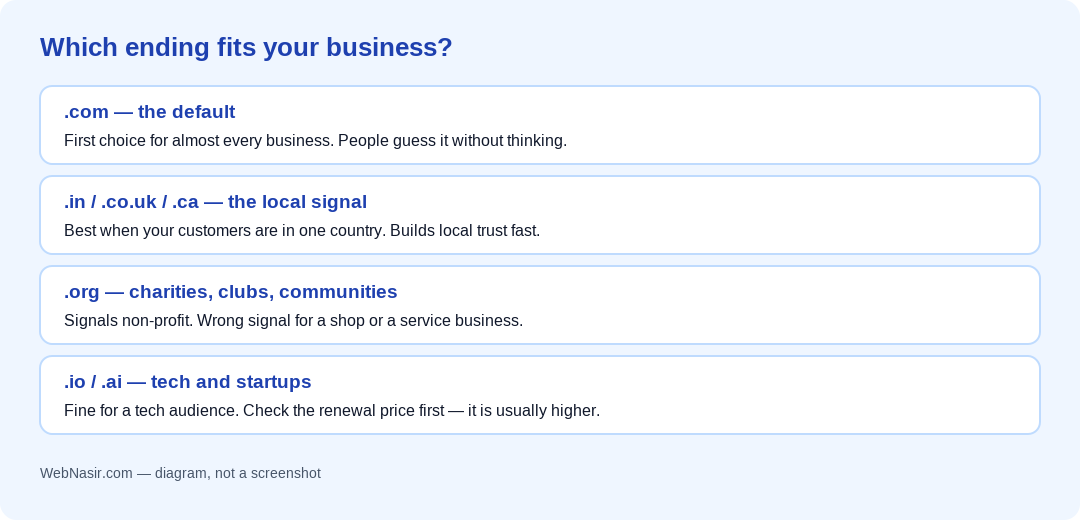
Start with .com, because it is still the default in most customers' heads. When someone hears your business name on the radio, in a shop, or from a friend, the address they type without thinking is yourname.com. That habit is worth more than any clever alternative. If the .com is available at a normal price, take it, even if another ending looks cheaper or more fashionable. The .com is the one ending you never have to explain, spell, or defend, and over ten years of saying your web address out loud, that adds up to thousands of small moments where a customer either finds you or gives up.
Country endings are the exception that proves the rule. If your customers are all in one country, the country ending can beat .com. A plumber in Manchester gains trust from a .co.uk address, because it tells a local customer this is a British business that works here. A shop in Jaipur gains the same from .in. A business in Toronto gains it from .ca. The local ending also helps in local search results, because Google uses it as one of many signals that your site is relevant to searchers in that country. Serious local businesses often hold both — the country ending as their main address, and the .com redirecting to it, so nobody is ever lost.
The endings to treat with care are the fashionable ones. There are now hundreds of new endings — .shop, .store, .online, .blog, .site, .app, .dev, and many more — and some of them are genuinely useful. A .shop address for an online store is clear and honest. A .app address for a software product makes sense. But two warnings apply. First, customers do not remember unusual endings. If you tell someone your address is sunshine.bakery, half of them will type sunshinebakery.com anyway and land on someone else's site, or on nothing at all. Second, some endings carry a renewal price several times higher than a .com, and a few carry rules you did not expect — .app and .dev, for example, only work over a secure HTTPS connection, which is fine if your site is set up properly and a nasty surprise if it is not. Check the renewal price and the rules before you fall in love with a clever ending.
Then there are the tech endings, .io and .ai, which deserve an honest paragraph because they mislead more founders than any other choice. The .io ending belongs to the British Indian Ocean Territory and .ai belongs to Anguilla, but both are marketed worldwide as tech endings, and both are now expensive to renew — check the registrar's current price before you commit, because the renewal is usually several times the price of a .com. For a software startup selling to developers, .io or .ai can be a genuine advantage: your audience knows the convention and trusts it. For a bakery, a clinic, a coaching centre, or any business whose customers are not developers, the same ending is a handicap. Your customers will misremember it, mistype it, and quietly assume your site is something else. Choose the ending your customers already understand, not the one your industry friends think is cool.
| Ending | What it signals | Best for | Watch out for |
|---|---|---|---|
| .com | Established, general, trustworthy | Almost every business | Often taken — see the taken-name section below |
| .in / .co.uk / .ca | Local business in that country | Businesses serving one country | Some country endings have residency or business rules |
| .co | Short, modern, global | Startups when .com is gone | People will still type .com by mistake |
| .org | Non-profit, charity, community | Charities, clubs, foundations | Wrong signal for a shop or service business |
| .net | Technical, network, internet | Tech and infrastructure businesses | Customers often assume it is a second choice |
| .io / .ai | Tech startup | Software aimed at developers | High renewal prices — check before buying |
| .shop / .store | Online shop | E-commerce stores | Customers may still try .com first |
| .app / .dev | Software product | Apps and developer tools | Only work over HTTPS |
The renewal-price trap, in full
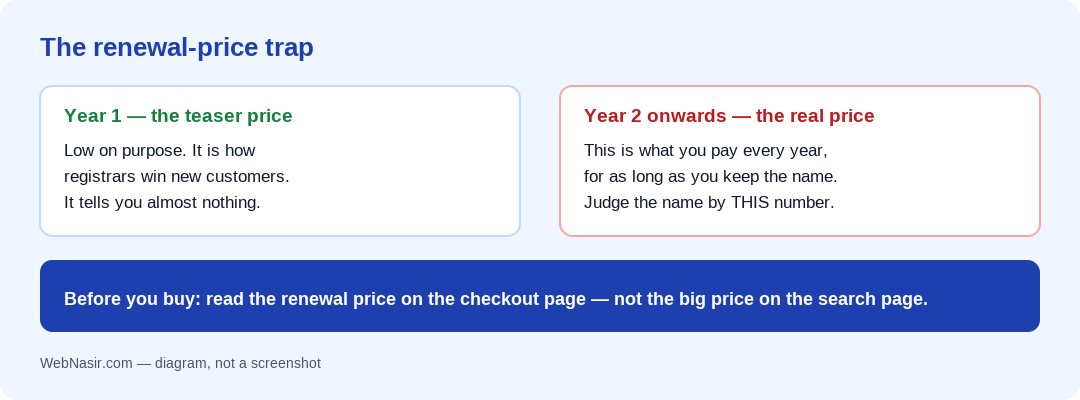
The single most expensive sentence in this whole guide is the price on the registrar's search page. It is almost always the first-year price, and it is almost always a discount designed to win you as a customer. The renewal price — what you pay in year two, year three, and every year after that for as long as you keep the name — is usually higher, sometimes several times higher, and it is printed in smaller text further down the page or on the checkout screen. I have seen business owners register a name for what looked like the price of a coffee, then get a renewal bill a year later that cost more than their hosting. They were not cheated. They just never read the second number.
Here is how to read the price properly before you pay anything. Search for the name, and on the results page look for two numbers: the registration price and the renewal price. If the page only shows one number, click through to the checkout and read the renewal line there before you confirm. Then do the five-year maths in your head: the first year at the discount price plus four years at the renewal price. That total is the real cost of the name. If the renewal price makes you uncomfortable, the name is too expensive, and you should pick another name rather than another registrar — because the expensive part is usually the ending, not the seller, and moving later will not fix it.
There are three more price traps beyond the renewal. The first is the premium name: some names are owned by resellers or by the registry itself and are listed at a high price, sometimes hundreds or thousands of times the standard price. If the name you want shows a price that shocks you, it is a premium or resale name, and the right move is almost always to pick a different name, not to pay it. The second trap is the transfer fee: moving a domain to another registrar usually costs about the same as one year of renewal and adds a year to your registration, which is fair — but check it before you move, and never move a domain in the sixty days after registering or transferring it, because the rules block transfers in that window. The third trap is the add-on pile at checkout: website builders, email packs, security seals, and search-engine submission services that are added to your basket by default. Untick everything you did not ask for. You can always add email or hosting later, on your own terms, and most of those add-ons are available free or cheaper elsewhere.
One honest exception to all of this: multi-year registration. Most registrars let you register a name for up to ten years at a time, and paying for several years up front locks in today's renewal price and removes the risk of forgetting a renewal. If you are certain about the name — you have checked the trademark, the handles, and the spelling — registering for three to five years is a sensible move for a real business. It is also a small trust signal: a name registered for five years looks more serious to anyone who checks than a name registered for one. But do not register for ten years on a name you have not tested yet. A year of living with the name will tell you more than any checklist can.
How to check a name will not get you a legal letter
A domain can be available to buy and still be a terrible idea, because availability and legality are two different things. The registrar will happily sell you a name that infringes someone else's trademark, and it will not warn you. The warning arrives later, as an email from a lawyer, and by then you have printed cards, built a website, and told your customers where to find you. Ten minutes of checking before you buy is the cheapest insurance in this whole process, and most of it is free.
Start with the simplest check: search the exact name on Google, in quotes, with no other words. If a business with the same or a very similar name already exists in your line of work, stop and think hard, even if they are in another city. Trademark law cares about confusion, not distance. A coaching centre in Jaipur called the same thing as a coaching centre in Delhi is a problem. A bakery with the same name as a software company is usually not a problem, because nobody confuses a cake with a codebase. The question is always the same: would a reasonable customer think your business is theirs, or is connected to them? If the answer is yes, or even maybe, pick another name.
Then check the trademark registers, which are free to search. In the United States, the trademark office runs a free online search system — look for the United States Patent and Trademark Office trademark search and search your exact name and close variations. In India, the government's IP India portal offers a free public trademark search. In the United Kingdom, the Intellectual Property Office has a free trademark search of its own. You are looking for live registrations in the same class of goods or services as yours. A dead or abandoned registration is usually not a barrier, but a live one in your field is a stop sign, not a speed bump. If you find something close and you are not sure what it means, that is the moment to ask a trademark lawyer for a one-hour opinion — it costs far less than rebranding a year later.
There are two kinds of names that get people into the most trouble, and both feel safe when you pick them. The first is a famous brand with a small twist: a coaching centre called a well-known education brand's name with Classes added, or a bakery using a famous biscuit brand's name. Big brands protect their names aggressively, and they have lawyers who do nothing else. The second is a name that is identical to a competitor's but with a different ending, like taking a rival's .com name on a .co or a country ending. That does not protect you. If anything, it proves you knew about them. The same applies in reverse: if someone later copies your name, your best protection is having chosen something distinctive in the first place and having registered the trademark yourself when the business could afford it. A domain registration is not a trademark. It gives you the address, not the exclusive right to the name.
If a dispute ever does arrive, know what the process looks like so you do not panic. For most domain disputes, the route is the Uniform Domain-Name Dispute-Resolution Policy — UDRP — a process run by approved providers under the internet's domain rules. The complainant has to prove three things: that your name is identical or confusingly similar to their trademark, that you have no legitimate interest in it, and that you registered and used it in bad faith. A genuine business using its own name in good faith is in a far stronger position than someone who registered a famous brand's name to sell it back. The process takes weeks and the filing alone costs real money, which is why most disputes start with a polite email, not a filing. Answer disputes calmly, keep records of when you registered the name and how you have used it, and get legal advice before you reply to anything that threatens action.
Your name has to work everywhere, not just on your website
A domain is only one of the places your business name lives. The same name has to work on Instagram, Facebook, YouTube, WhatsApp Business, your Google Business Profile, your email address, your shop sign, and your printed card. A name that is perfect as a domain and unavailable everywhere else is a name that will confuse your customers for years, because every time they search for you on a platform, they will find someone else — or nobody at all. Check the handles before you buy the domain, not after. It takes five minutes and it changes the decision surprisingly often.
The check is simple. Take your shortlisted names and search each one on the platforms your customers actually use: Instagram, Facebook, YouTube, and X if your audience is there. You are looking for an exact or near-exact handle that is free, or at least not taken by an active business in your field. A dormant account with three posts from five years ago is annoying but survivable — you can use a small variation like adding your city or the word official, and customers will still find you. An active business with the same name in the same field is a real problem, and it is the same problem as the trademark check above: confusion. If the handle is taken by an active competitor, treat the name as taken and move on to the next one on your list.
Your email address deserves the same attention, because it is the part of your domain your customers will type most often after the website itself. An address like hello@yourbusiness.com looks professional and is easy to remember. An address like yourbusiness123@gmail.com tells every customer you have not set up properly yet, and it puts your business email in an account you do not control in the same way. Set up email on your own domain in the first week — most registrars and hosts offer a mailbox or let you connect a free or low-cost email service — and put that address on everything. And check the spelling out loud: if your domain is hard to spell, your email is hard to spell too, and every phone call will include a spelling lesson. That is the radio test again, applied to the inbox.
Finally, think about the printed world, because your domain will live there longer than anywhere else. Shop signs, visiting cards, packaging, vehicle stickers, and invoices all carry the name, and reprinting them costs real money. Before you commit, print the name at the size it will appear on a card and look at it from arm's length. Does it read clearly? Does it look like a different word at a glance? Does it contain a letter combination that reads badly when the dot is removed — the classic trap where a harmless name becomes an unfortunate phrase once the spaces disappear? Read it with fresh eyes, or better, show it to someone who has never seen it and ask them to read it back. If they hesitate, or laugh, you have just saved yourself a reprint.
When the name you want is already taken

Almost every good name is taken. That is not a disaster; it is the normal state of the internet after thirty years of registrations. The question is never whether your first choice is available. The question is what you do next, and the wrong move here is the one that costs the most: forcing a bad version of the name you wanted instead of choosing a good version of a different name. A name with a hyphen, a number, a misspelling, or a strange ending is not your first choice. It is a compromise that your customers will pay for, one mistyped address at a time, for years.
- Add a word your customers already use — get, try, shop, studio, labs, or a word from your trade, like bakes for a bakery or repairs for a workshop.
- Add the place — your city or area — if you serve customers there, which also helps local search.
- Switch the ending to your country extension, if your market is local.
- Make a fair offer to buy the name, through an escrow service, and only if the price is sane.
- Walk away and pick a fresh name from your shortlist — the option most people skip and most often regret skipping.
The first three routes are free and they work because they keep the name natural. Adding a short, honest word in front of your name — get, try, shop, or a word from your trade — produces an address people can still say out loud without embarrassment. Adding your city works the same way, and it has the side benefit of telling every customer exactly where you are. Switching to the country ending works when your customers are local. What does not work is adding a random word that means nothing, bolting on a number, or inventing a spelling. If the variation needs explaining, it is not a variation. It is a different, worse name.
Buying the name from its current owner is a real option, but it has rules, and breaking them is how people lose money. First, find out who owns it — a WHOIS lookup will usually show the registrar, and often a contact address if privacy protection is off. Second, decide your maximum price before you make contact, and do not exceed it; a name is worth what it earns you, and most small-business names are worth far less than their owners hope. Third, never pay by direct bank transfer or a payment app. Use a licensed escrow service — a neutral company that holds your money until the domain is transferred to you, and only then releases it to the seller. Escrow services charge a fee, and that fee is the cheapest protection in the whole transaction. Fourth, check the name's history before you pay: a name that was previously used for spam or a scam can carry penalties in search results that follow it to you. A quick search of the name's history and a look at what it hosted before will tell you most of what you need to know.
And then there is walking away, which deserves more respect than it gets. Every business owner I have worked with who paid too much for a name, or forced a bad spelling, tells the same story a year later: they wish they had picked the second name on their list. The second name was free, it was clean, it passed the radio test, and nobody would ever have known it was second choice. Your customers never see your shortlist. They only see the name you chose. A fresh, clear, available name beats a famous, expensive, compromised one every single time, and the sooner you accept that, the sooner you have a website to build.
Does a domain name help your Google ranking? The honest answer
This is the question every business owner asks, and the honest answer is less exciting than the people selling keyword domains want you to believe. Years ago, a domain that exactly matched a search phrase — something like bestplumberinjaipur.com — really did rank better, and an industry grew up around buying those names. Google closed that gap a long time ago. Its own spokespeople have said repeatedly that a keyword in your domain is not a ranking factor worth chasing, and that exact-match domains no longer get the advantage they once had. What ranks a page is the content on it, the links pointing to it, and whether searchers find it useful — not the words in the address bar.
That does not mean the domain is irrelevant to search. It matters in three indirect ways, and all three are about people, not algorithms. First, a clear, memorable domain gets clicked more often in search results, because people trust an address they understand. A result from sunshinebakery.com gets more clicks than the same result from best-cakes-4u-shop-online.net, and clicks are a signal Google does notice. Second, a brandable domain gets linked to more often, because other sites are happy to link to a real business name and embarrassed to link to a spammy-looking address. Third, a country ending helps with local search, because it is one more signal — alongside your address, your Google Business Profile, and local reviews — that your business serves searchers in that country. All three effects are real. None of them requires stuffing keywords into the domain.
The practical rule follows from that. If you can have a name that is both brandable and descriptive — a real business name that also says what you do — take it. IslamicNameFinder.com is a good example from my own work: it is a brand and a description at the same time, and searchers type almost those exact words. But if you have to choose between a clean brand name and a clumsy keyword name, choose the brand every time. A keyword name might win you a small advantage for one search phrase this year. A brand name wins you returning customers, word of mouth, and links for the next ten years, and those are the things that actually rank. And never buy a domain because someone promised you it will rank on its own. A domain is an address, not a strategy.
Country domains: the rules nobody reads until it is too late
Most country endings are open to anyone, but some are not, and the ones that are not will block you at the checkout — or worse, take the name away later. The rules exist because country endings are managed by national registries, and each registry sets its own conditions. Before you build a business around a country ending, read its rules. It takes two minutes on the registry's own site, and it is the difference between a name you own and a name you rent on borrowed time.
India's .in is open: anyone in the world can register one, with no local address or business needed, which is why it works so well for Indian businesses and for anyone serving Indian customers. The United Kingdom's .co.uk is equally open, with no residency requirement. Canada's .ca is different: the registry requires a Canadian presence, such as living in Canada, owning a Canadian business, or holding a Canadian trademark. Australia's .com.au is stricter still: you generally need an Australian business number or a registered Australian company or trademark, and the name itself must be closely connected to that business. The United States' .us requires a connection to the United States — living there, doing business there, or being a US citizen or resident. These are not obscure edge cases. They are the rules for four of the most commonly considered country endings, and they catch real businesses every month.
The other rule to know about country endings is what happens when you stop qualifying. A business that closes its Australian company and lets its business number lapse can lose the right to hold its .com.au name. A person who moves away from Canada can find their .ca renewal questioned. None of this is a reason to avoid country endings — for a local business they are the best choice, as the earlier section said — but it is a reason to hold the matching .com as well when you can, so that your business has a fallback address that nobody can take away for a paperwork reason. Buy the pair when the second name is available at a normal price. It is the cheapest insurance you will ever buy for your brand.
| Ending | Who can register | What the registry asks for |
|---|---|---|
| .in | Anyone, anywhere | No local presence needed |
| .co.uk | Anyone, anywhere | No residency requirement |
| .ca | People and businesses with a Canadian connection | Canadian presence — residence, business, or trademark |
| .com.au | Australian businesses | Australian business number or registered company/trademark |
| .us | People and businesses with a US connection | US residence, citizenship, or business presence |
| .co | Anyone, anywhere | No local presence needed — marketed globally |
One more quiet fact about country endings: they are managed by national registries, and those registries can change their rules. Prices, eligibility, and dispute procedures for a country ending are set by that country's registry, not by your registrar, and not by the global domain rules that govern .com. That is not a warning against using them — millions of businesses do, safely — but it is a reason to keep your registrar account in good order, keep your contact details current, and never let a country-ending domain lapse, because recovering a lapsed country domain is often harder than recovering a lapsed .com.
Choosing a registrar: the five things that matter more than the first-year price
A registrar is the company you buy the domain from, and your choice matters more than most people think, because this company will hold your business's address for years. A bad registrar makes everything harder: renewals fail, transfers are blocked, support does not answer, and the checkout is full of traps. A good registrar is boring in the best way — clear prices, free privacy protection, easy transfers out, and support that answers. You will interact with this company maybe twice a year, but those two interactions decide whether your website stays online.
Here is what to check, in order. First, the renewal price, not the first-year price — the trap covered above, and still the most important number. Second, free privacy protection: your name, address, and phone number are published in the public WHOIS directory unless privacy protection hides them, and most good registrars now include it free. If a registrar charges extra for privacy, that is a sign their business model is built on add-ons. Third, easy transfer out: a good registrar lets you unlock the domain and get your transfer code in a few clicks, with no phone call and no waiting period. If you have to email support or wait days, you are locked in, and you will feel it the day you want to leave. Fourth, two-factor authentication on the registrar account itself — if the registrar does not offer it, your domain is one stolen password away from being transferred to a thief. Fifth, real support: a help centre that answers, and a way to reach a human when something goes wrong at renewal time, which is the one moment you cannot afford a three-day wait.
| What to check | What good looks like | Red flag |
|---|---|---|
| Renewal price | Clearly shown before checkout | Only the first-year price is shown |
| Privacy protection | Included free | Charged as a paid add-on |
| Transfer out | Unlock and code in a few clicks | Requires a phone call or support ticket |
| Account security | Two-factor authentication offered | Password only, no second factor |
| Support | Answers within a day | No human contact route at all |
| Checkout | Only what you asked for | Pre-ticked add-ons in the basket |
A few names come up in every honest discussion of registrars, and they are worth naming because they represent genuinely different models. Cloudflare Registrar sells domains at wholesale cost with no markup, so its renewal price is usually close to the lowest available — the trade-off is that it is a no-frills service aimed at people who already know what they are doing. Namecheap and Porkbun are popular with small businesses because they include privacy protection free, show renewal prices clearly, and make transfers straightforward — check the registrar's current price for your ending before you decide, because prices change. The big household names spend the most on advertising and often charge more at renewal, which is not a reason to avoid them — their support and brand recognition are real — but it is a reason to compare the renewal price before you buy, rather than after. And one rule that applies to every registrar on this list: buy the domain in your own account, in your own name, with your own email address. If an agency, a freelancer, or a well-meaning relative buys it in their account, they own your address, and getting it back can take months. That rule is worth more than any price comparison in this section.
Three names, worked end to end
Rules are abstract until you watch them applied to a real business. Here are three shortlists built the way this guide teaches: say it out loud, check the spelling, check the ending, check the trademark, check the handles, and read the renewal price. The businesses are invented, but the reasoning is exactly what I do with real clients, and the mistakes avoided are real ones I have seen.
A home bakery in Jaipur
The baker's first idea is her own name plus bakes, in a .com, because it is personal and easy to say. If the .com is taken, the next move is not a hyphen or a number — it is the .in ending, because her customers are in Jaipur and the local ending builds trust with them. A second option adds the city itself, which helps local search and tells every customer where the cakes come from. What she must not do is copy a famous bakery brand with a small twist, or pick a clever spelling that nobody can type after hearing it once on the phone. Her email becomes hello@hername, her Instagram handle matches, and her visiting card carries one address that works everywhere. The whole decision takes an afternoon, and it lasts for the life of the business.
A plumber in Manchester
The plumber's customers are local, in a hurry, and usually calling from a phone with a leaking pipe in the background. His name has to pass the hardest version of the radio test: said once, over a bad connection, by a stressed customer. That rules out anything long, anything with a silent letter, and anything that needs spelling. His best options are his surname plus plumbing, or his surname plus the area he serves, on a .co.uk ending — the local signal matters more for him than a .com, because his customers are all in one country and they trust a British address. He buys the .com as well if it is available at a normal price, and points it at the same site, so nobody is ever lost. He sets up auto-renew on day one, because a plumber whose website disappears for a week loses the week's emergency calls, and those are the ones that pay.
A small software tool for invoicing
The software founder's audience is global, technical, and spread across countries, so a country ending is the wrong signal and .com is the right one. Her first choice is a short brand name that means nothing on its own — the kind of name that can grow beyond invoicing if the product grows — and she checks the trademark registers in the United States and India before she falls in love with it, because software is exactly the field where trademark disputes happen. If the .com is taken, her next move is adding a short honest word like get or app in front of the name, not a hyphen and not a misspelling. She checks the .io ending and finds the renewal price is several times the .com, so she treats it as a fallback, not a first choice. She registers the name for three years, turns on two-factor authentication, and buys the matching social handles the same day, because for a software product the name is the brand, and the brand is the business.
Protecting the name once it is yours
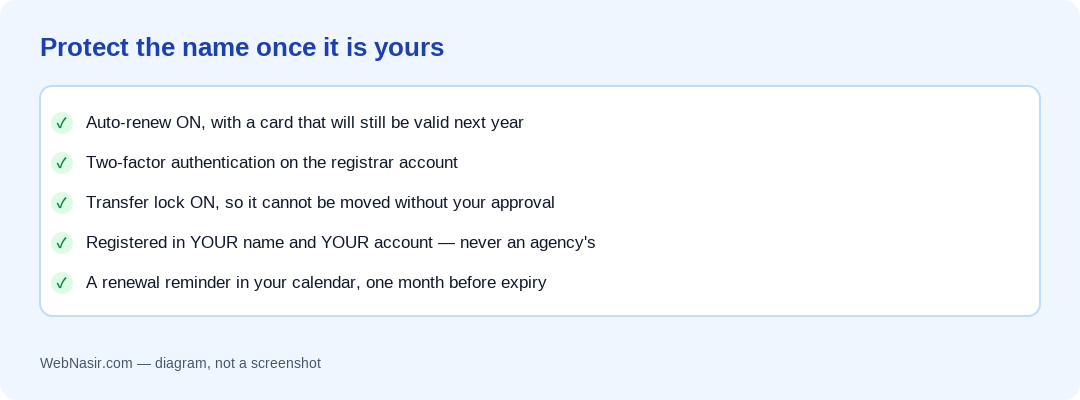
Buying a domain is the easy part. Keeping it is where businesses fail, and the failures are almost always boring: a card expired, an email went to an old address, nobody noticed, and the website went dark. A domain that lapses does not just take your website down. It takes your email down with it, so the messages telling you about the problem go to an address that no longer works. Set up the protection in the same hour you buy the name, while you still remember the password and the account details, and you will never have to think about it again.
The first layer is auto-renew, switched on, with a payment card that will still be valid next year. Check the card's expiry date against the domain's renewal date right now — if the card expires before the domain renews, the renewal will fail silently. The second layer is the contact email on the registrar account: it must be an address you actually read, not an old inbox you abandoned, because every renewal warning and every transfer approval goes there. The third layer is two-factor authentication on the registrar account, which stops the most common form of domain theft — someone getting your password and transferring the name away. The fourth layer is the transfer lock, a setting at the registrar that blocks transfers until you switch it off. Keep it on always, and switch it off only for the few days when you genuinely need to move the name.
For a name that becomes genuinely valuable — a business doing real revenue through its website — there is a fifth layer worth knowing about: a registry lock. This is a stronger lock applied at the registry itself, not just at your registrar, and it usually requires a phone call or a manual verification to remove. It is overkill for a new business, and some registrars charge for it, but for a name that would cost you serious money to lose, it is the right level of protection. The same thinking applies to the people side of protection: write down where the domain is registered, which account holds it, and when it renews, and keep that note somewhere your business partner or family can find it. Businesses have lost domains because the one person who knew the login left, fell ill, or simply forgot. A domain is a business asset. Treat it like one.
If the worst happens and a name does lapse, act fast and know the shape of what follows. After expiry there is usually a grace period — typically around thirty days — during which you can still renew at the normal price, though your website and email may already be down. After that comes a redemption period, also usually around thirty days, during which you can still get the name back but only by paying a redemption fee on top of the renewal, and the fee is not small. After that the name is released and anyone can register it, including the resellers who watch expiring names for a living. The exact lengths of these windows vary by registrar and by ending, so check your registrar's own policy rather than taking any number here as a promise — but the shape of the story is always the same: the longer you wait, the more it costs, and one day later it costs everything. A calendar reminder one month before expiry, every year, is the cheapest fix.
Changing a domain later: the honest cost
Sometimes a business outgrows its name. The bakery becomes a restaurant group, the local shop starts selling nationwide, or the name that seemed fine at the start turns out to be a spelling nightmare. Changing a domain is possible, and businesses do it successfully every year — but it is the most expensive marketing job most small businesses will ever do, and it should never be undertaken lightly. The cost is not the new domain. The cost is everything the old domain accumulated: links from other sites, search rankings, printed material, and the memory of every customer who knows the old address.
The technical part is straightforward and has a clear order. First, map every page on the old site to its matching page on the new site — not everything to the homepage, but each page to its closest equivalent, because a redirect to the homepage tells Google the old page is gone and its value goes with it. Second, set up permanent 301 redirects for every mapped page, so visitors and search engines are forwarded automatically. Third, tell Google through Search Console's Change of Address tool, submitting a request for every variant of the old domain — the www and non-www versions and each subdomain — because Google treats each variant separately and the tool does not move them for you. Fourth, update everything you control: your Google Business Profile, your social profiles, your email signatures, your directory listings, and your links from any site you own. Fifth, keep the old domain and its redirects running for at least a year — Google's own guidance says to keep redirects in place for at least a year and ideally longer, and Google's Change of Address signals continue for about 180 days — because links on other people's sites will keep pointing at the old address for years, and every one of them is a customer arriving at a door you have to keep open.
The human part costs more than the technical part. Every visiting card, sign, menu, invoice template, vehicle sticker, and piece of packaging carries the old name, and reprinting them all is a real bill. Every customer who memorised the old address will type it for months, and some will give up when it changes. Every email address on the old domain has to be moved or forwarded, and someone will inevitably keep writing to the old one. That is why the first section of this guide — choosing well the first time — matters so much. A day spent choosing properly now saves a month of migration later. And if you do change, do one thing at a time: change the domain, but do not redesign the website and switch platforms in the same week, or you will never know which change caused any drop in traffic. Google's own site-move guidance says the same thing, and it is right.
More questions, answered
How many years should I register a domain for?
One year is fine while you are testing a name, and it is what most people do first. Once you are sure — you have checked the trademark, the handles, and the spelling, and the business is real — registering for three to five years is the sensible move. It locks in today's renewal price, removes the risk of a forgotten renewal, and looks more serious to anyone who checks. The maximum in one go is ten years, and there is rarely a reason to go that far unless the name is the core of the business and you never want to think about it again.
Is .co a good substitute for .com?
It is the best of the substitutes, because it is short, easy to say, and widely understood — .co is Colombia's country ending, but it is marketed globally and used by startups everywhere. The problem is human habit: a meaningful share of your customers will still type .com out of muscle memory and land on someone else's site. If you use .co, buy the .com as well when you can, even if it is only to redirect it, and always say the ending clearly when you give out the address. Never say just the name and hope people guess.
Are hyphens ever acceptable in a domain?
Almost never, and the reason is the radio test. A hyphen is invisible in speech: when you say your address out loud, you have to explain where the hyphen goes, and half your listeners will forget it or put it in the wrong place. Search engines do not penalise hyphens, so this is not an SEO rule — it is a human rule. The only honest exception is a two-word name where the hyphen genuinely prevents confusion, and even then a different name is usually better. If the unhyphenated version belongs to someone else, treat the name as taken and pick another one.
Should I buy the misspellings of my domain?
For most small businesses, no. Buying every misspelling is a game with no end — there are always more misspellings than you can buy, and the money is better spent on the business itself. The exception is a name with one obvious, common misspelling that your customers genuinely make, or a name where a single-letter mistake sends people to a competitor or to something embarrassing. Buy the one or two that matter, point them at your real site, and stop there. The same applies to buying every ending: the .com and your country ending are worth holding; the other forty are not.
Can someone steal my domain?
Yes, and it happens through the registrar account, not through the domain itself. The usual route is a stolen password, a phishing email pretending to be your registrar, or a social-engineering call to support. That is why this guide keeps repeating the same three protections: two-factor authentication on the registrar account, a transfer lock switched on, and a contact email you actually read. If a transfer you did not approve ever starts, contact your registrar immediately — transfers take days, not minutes, and there is a window to stop one if you act fast.
Do I need hosting to buy a domain?
No. A domain and hosting are two separate purchases, and you can buy the domain first and decide about hosting later. In fact, buying the domain first is the right order: it secures the name while you take your time choosing a host and building the site. Many registrars will offer you hosting at the checkout — you can safely decline it and come back when you are ready. When you do choose hosting, keep the domain at the registrar and point it at the host, rather than moving the domain to the host, so that the two stay independent and you can change hosts without risking the name.
What if two businesses in different countries have the same name?
It happens constantly, and it is usually fine. Trademark rights are generally territorial and tied to a field of business, so a bakery in Jaipur and a bakery in Manchester can often share a name without any problem — they serve different customers in different places, and nobody is confused. The problem starts when one of them goes online and starts serving the other's market, or when one of them is a famous brand. If you plan to sell internationally, check the trademark registers in the countries you plan to sell in, not just your own, before you commit to the name.
The decision worksheet: your final fifteen minutes
- Say each shortlisted name out loud on a fake phone call. Cross out any name you have to repeat or spell.
- Type each name with your eyes closed. Cross out any name you mistype.
- Search each name on Google in quotes. Cross out any name owned by a business in your field.
- Check the trademark registers for your country. Cross out any name with a live registration in your field.
- Check the social handles and the country ending. Cross out any name that is taken everywhere else.
- Read the renewal price, not the first-year price. Cross out any name whose renewal makes you uncomfortable.
- Show the survivors to two people who have never seen them. Ask them to read each one back and say what the business does.
- Buy the winner in your own account, with auto-renew on, privacy protection on, and two-factor authentication switched on.
That is the whole process. Fifteen minutes of checking, and you own a name that will serve the business for a decade. Most of the businesses I have watched struggle with their domain did not fail because they were unlucky. They failed because they skipped one of those eight steps — usually the phone call, the trademark search, or the renewal price — and discovered the problem a year later, when fixing it cost real money. You have just read the guide. Do the worksheet. Then go and build the website, because the name was never the business. It was only ever the address, and now you have a good one.
One last thought, from someone who has given this advice to clients for years: the best domain name is rarely the cleverest one on your list. It is the one a tired customer can remember at midnight, type correctly on a phone with one thumb, and find again a month later without searching. Short, spellable, honest, and yours. If the name on your shortlist does all four of those things, stop searching and buy it. The perfect name does not exist, but a good name, bought today and used well for ten years, beats a perfect name that you never get around to choosing.